
The Temagami area is well known for having a wide variety of mushrooms and other related fungi throughout the growing season which begins in late spring and lasts through to the freeze-up in early autumn. As a general rule for this area, this will occur from early May through mid to late September and occasionally, into October.
Typical locations preferred for both the photographer and picker/harvester would be in an undisturbed forest location with a rich layer of decomposing plant material, plenty of natural moisture and protection from harsh sunlight .... as is found under the conifers throughout most of the White Bear Old Growth Red and White Pine Forest which is located directly in front of the lodge. Other areas with a predominance of deciduous hardwoods such as maples and birch also offer an abundant variety of mushrooms and fungi.
Some species are edible and very delicious when picked at their peak of growth and prepared quickly after harvesting. Other species are known to be poisonous and cannot be consumed under any circumstances. Due to the literally thousands of varieties of mushrooms growing in Ontario, most species have never had a toxicology test done on them to determine their edibility so they fall into the category of "unknown edibility" and should be avoided. If anyone is a mushroom enthusiast and looking for a career in science & food studies, here is a perfect opportunity to pursue and develop your interests that will give you a "job for life". So far, I have photographed and briefly catalogued only a couple hundred varieties around Temagami and they are described below. I have barely scratched the surface. As with all species of mushrooms, it is imperative that the picker/harvester can positively identify each particular mushroom and understands exactly the consequences of his/her actions.
For those that follow this website on a regular basis, you have noted that I gladly accept new ideas and suggestions on how I can improve this site. Over the years, I've had an endless amount of emails expressing thanks for pointing out a variety of edible mushrooms and readers have said they have tried a few and thoroughly enjoyed them. Recently, someone inquired as to why I haven't offered any of my recipes on how to cook mushrooms. Quite frankly, this had never crossed my mind. So here's the challenge and invitation to all fungii conniseurs: what is your favorite mushroom recipe(s)? Send them in and if there is sufficient interest, I will start a new page of recipes ... not only for mushrooms but I just might include wild game and fish dishes also. If you'd like your 15 seconds of fame, give me a "yes or no" on adding only your name and town below the recipe.
Warning: Extreme caution is urged when contemplating the harvesting and consumption of mushrooms and other fungi. If you cannot positively identify it, don't eat it. Please remember that there is no guarantee that any mushroom or fungi will not cause harm or discomfort to some individuals. Northland Paradise Lodge and its staff assume no liability or responsibility to anyone due to their actions in this regard.
The following photos, Latin & common names as well as a limited description of each are examples of just a few of the many different species found throughout the Temagami region. I realize there are several methods of compiling mushrooms into various classifications of genera, families and species but for ease of simplicity, I have arranged them according to their order of emergence in a calendar year. Hopefully, this will assist both photographers and harvesters in their quest of a particular species.
Both mushrooms and fungi have a tendency to reappear in the same area in following years. As a photographer, if you are a few days or weeks late in capturing that "perfect" shot, record the site and date and re-visit it earlier next year. As a picker/harvester, remember that the reproduction of your favorite delicacy depends upon spore distribution. Yes, pick and enjoy some of them but please leave others to reproduce naturally so you can reap the benefits of next year's crop. Do not "kick them around" to spread unripe spores over a greater area; Nature put these ones here and it can accomplish the reproduction of the spores all by itself.
Enjoy!
Photo Tours and Guidebook Sales
Depending on weather and sufficient growth of fungi, I offer guided tours for both photographers and harvesters looking for mushrooms in and around the Temagami area. Guide books will be offered for sale, both before and after the tours that are usually held on Saturdays and Sundays for 2 or 3 weekends around mid September. Bug repellants and boots are not required as hiking shoes and a jacket will be sufficient. Bring your own camera/cell phones for the pics and a shopping bad & short knife if you'd like to take some home for dinner. Admission is $30 and the tour last 4 or 5 hours, depending on interests and questions. Watch this site for more info, dates and location after mid August.
Weekly Mushroom Report for 2025.
Thursday, June 12, 2025. It's been a real slow year so far for sighting of any mushrooms in the Temagami area. I haven't heard of anyone fiding anything edible yet, especially the spring morels. I did see a few false morels but they are definitely inedible, but still pretty. Hopefully, things will improve soon. If anyone finds some weird looking fungi that they hve never seen before, please don't pick it but take a photo from ground level, flip it to me and I can probably identify it , along with edibility, for you. If I've never seen it before, I'd like to visit and take a photo of it myself. Thanks in advance.
Weekly Mushroom Report for 2024.
Friday, October 11, 2024. After the dry spells of a few weeks ago, we did receive good rains but the mushroom crop never materialized as I had hoped for. Yes, there were a few varieties to harvest and enjoy but overall, all mushrooms were not that common. There was a wonderful flush of honey mushrooms but the shaggy manes were scarce at the best. Even the poisonous Amanitas that make for beautiful photographs were not as plentiful this year. Our warm fall days are behind us now and the cold weather coming our way won't bring a plentiful showing. The best hope for another good harvest of delicious mushrooms is if the Velvet Stalk will come after the first snowfalls. The picture of these are the last photo at the bottom of this page and they are easily recognized as clusters growing up the trunks of trees late in the fall.
Sunday, September 22, 2024. Another weekend has come and gone and there's still no mushroom tours being made. We did get 2 inches of rain a week ago and I thought that would be a definite marker for good growth of all kinds of fungi. Nope .... did not happen. It's been hot and dry all week since then and there's just not much out there to look at and I've covered several well-known locations. However, I did find 3 new-to-me varieties that I've never seen before and I did take some high quality cell phone pics of them. Now all I have to do is figure out how to get them from that phone and onto my house computer so I can crop, brighten and move them from there to the website mushroom page. Wish me luck on that one. I'll post names so all of you can see that I actually do find interesting thing every once in a while. Later this week, rain is supposed to start late Tuesday and continue all through Wednesday so we just might have enough fungi growing by the weekend to call it a tour date. Stay tuned and you'll hear it in here first, then Facebook and aftewr that everybody can tell all their friends about it. I'd appreciate people that are planning on joinging the tour to call in with a head-count so I can plan tours that won't be too crowded.
Sunday, September 1, 2024. I have not seen a lot of any of the usuals this past summer. Boletes, in general, were a poor crop, as were the chanterelles. There have been some lobster mushrooms but few & far between and of a lower quality than normal. Hopefully, last week's rains and the cooler temps now will bring on a good crop of everything. People have been asking about the mushroom walks/tours and I will be offering them again if there are suffuiicient fungi to make it worthwhile. Various signs in Narture are all pointing to an earlier than normal fall and a possibly month-early winter this year. If ayone has a regular location that they harvest from every year, I'd suggest starting earlier this year so as not to miss them.
Tuesday, July 2, 2024. I don't have much to talk about. Sightings of any fungi are far and few between. We've had sufficient rains to keep the forest floor moist but it's still early in the season for any edibles to be present. Anything that I have seen are not edible and surprisingly, I haven't seen any puffballs of any varieties yet. By the end of the month, we should be picking a lot more of these delacasies.
Sunday, June 2, 2024. It's been a crazy spring with low winter snow accumulations, spring temps that yo-yo all over the place, hot spells and then frost just this past mid week. However, it's been a great spring for morel collections and folks are still finding them on a regular basis. The ground is still unusually cold for early June, people are just planting gardens (mine will be the coming week) and except for the morels, there's nothing out there to even look at. When more show up, you'll read about it in here first.
Weekly Mushroom Report for 2023.
Wednesday, November 8, 2023. For all practical purposes, mushrooms are done for this year. It was a disappointing fall as very few of the usuals such as fall oysters, Shaggy Manes and the late season boletes were here. Honey mushrooms were hard to find but I did enjoy a few meals of them. We have had a few snowfalls and light frosts and there's a tiny bit of frozen ground now. The only variety that might show up will be the Velvet Stalk which does appear at the base of tree trunks in late fall after a few snows, but not every year. For a photo of them, it's the last picture at the bottom of this page. Thanks to everyone for following this report all summer and I look forward to seeing all of you again in '24. This will probably be the last posting on this page for '23.
Thursday, October 5, 2023. It's been an extremely dry fall this year and the mushrooms just aren't there in the number of varieties and quantities that we are used to. A friend did give me a small handful of Slippery Jacks this past week that he picked in his yard and we found some Honey mushooms yesterday and we pigged out on them last night ... but that's it! There's supposed to be 2 or 3 days of rain this weekend and then cooler weather so maybe it will bring out a few more fungi to photograph and harvest. But right now, there's no plans for a mushroom tour yet. Maybe the rains will change that all around for next weekend. Stay tuned in here and on Facebook for updates, if any.
Friday, September 22, 2023. I've had several requests lately concerning the annual mushroom tours that I have offered in past years. I thought we have had sufficient rains for all fungi to grow over this past month or two but Nature hasn't quite seen it that way. I've been out and about in the forests on a regular basis and yes, I have seen mushroom but very few are of the edible kind and all varities are few and far apart. It's getting late for tours and I can't foresee it happening again this year for the second year in a row. If it should show a good variety, I will certainly be posting a tour in here and a few other palces such as Facebook ... which I'm not good at but I have friends that can help me with that. Stay tuned for any updates.
Saturday, August 26, 2023. Even though we've had sufficient rains over the past few weeks, mushrooms aren't as plentiful as I had hoped for. The big surprise was the lack of almost all of the varieties of bolettes everywhere this year.Chanterrelles are scarce also but the lobsters are doing quite well. I've had several calls and emails inquiring about mushroom tours this fall. All I can say at this time is that, yes, there will be tours offered if I find sufficient varities of all mushrooms, both edible and non-edibles, to warrant a walk in the forest. Stay tuned both in here and on Facebook for these weekly updated notices over the next month.
Tuesday, August 1, 2023. Sufficient rains over the past couple weeks have started to show some mushrooms appearing. Although they are not plentiful yet, the bright orange lobsters and yellow chanterelles are popping up. There have been very few bolettes of any kind being found. A friend stopped in and gave me some black trumpets that he had foraged south of North Bay so I would imagine they will be appearing up here in a week or so. Good luck with your search for these delicasies and if you'd like to share your findings, I can post that info in here... but not the exact hidden locations of your find.
Tuesday, July 3, 2023. Northern Ontario has has an unusally dry spring through the early summer this year and there is very little greenery anywhere in the bush. I did see a handful of False Morals (poisonous) a while back but overall, there has been very little fungi anywhere. Hopefully, significant rains over the next 4 to 6 weeks will lead us to a bountiful late summer and autumn harvest of Nature's finest delacasies.
Weekly Mushroom Report for 2022.
Wednesday, November 30, 2022. My apologies for the space between this and the previous report for the summer. I think we have finally found and deleted the culprit that was holding back the postings. Although we had sufficient rains this fall, there were noticably fewer fungii anywhere so pickings were scant. There were not any mushroom tours offered this year. All of the bolettes were conspicuously absent for most of the summer but a few were found on rare ocassions. Shaggy Manes were hard to find in the late fall. Lobsters and chanterelles were the most abundant and even they were hard to locate in the usual great numbers. Here's hoping next year will be more productive.
Wednesday, August 3, 2022.The month of July was very dry and mushrooms were non-existant. For the past week or more, we've had steady but occasional light rains and the forest is again starting to show some life everywhere. Although not plentiful, Lobsters and Chanterelles can be found with sufficient efforts. With the hottest summer temperatures behind us now, more varieties such as all the bolettes should be appearing over the next couple weeks. It's too early and there's currently too few varieties to have the annual mushroom tours yet but I will be hosting them when conditions, varieties and quantities improve, probably at the end of August or early September.
Wednesday, June 8, 2022. It's been an unusually slow spring for all sightings so far this year. I checked the usual areas for morels which are prime when the wild strawberries are in white bloom a couple weeks ago and I never found a one anywhere. Ditto for the spring white oyster mushrooms. Althought they are not edible, I haven't even seen any of the LBM's (Little Brown Mushrooms) in the lawn this year. I haven't had the time to brouse through the forests or along ATV trails so I can't say what might be out there. If anybody sees anything new to them, please don't pick it but snap a quick pic then just call me and we can take a second look at it and hopefully we will have a new pic to add to the ever growing list.
Musshrooms that I just cannot identify
 I found this cluster of tiny mushrooms growing on the inside of the flower box in front of the lodge window in late August. The wood is a 6 X 6 pressure treated timber and for the past few years, the flowers have been gladiolas. There are probably 200 individuals in the clump and none are larger than 10 or 12 mm. in diameter. The cap is bell-shaped and the top of the bell has ridges halfway down the cap.The skinny dark stalk has the wide-spaced gills attched but then there is a break before continuing under the cap. Overall, it appears very similar to Xeromphalina cauticinalis which has a dimple in the smooth top of the cap, the gills are continuous into the stalk and it doesn't grow in these same tight clumps. I can only assume this mushroom is in the same family but it doesn't show in any of my many refrence books either.
 This pic was submitted by a friend, Tracy from Englehart and neither of us can identify it in any of our many reference books. It was found on the base of a large spruce tree in late August and appears to be a toothed fungus but the teeth usually appear on the bottom side of the mushroom, not the top, as pictured here. She said it is quite large, for scale, perhaps the size of a dinner plate and is at least 6" thick. From a distance, it looks like spray foam, a similar yellow/orange colour. Has anybody ever seen it before?
 What is this? I found this weird fungi a couple years ago in early October and I still can't find anything like it in any mushroom guide books nor on Google Images. It is flat & close to the ground, has a dull gray or flat black colored top and spreads everywhere. The weird part is the many tiny carrot-shaped white roots below the cap that are only visible if you turn up the duff layer that it grows in. Any assistance in identifying this (and all the others below) would be greatly appreciated. Note: I got a message today that it is called Pelt Lichen, Peltigera membranacea so I can now re-post it. Thanks.
 Here is an unidentified mushroom that I have found growing on the side of a living spruce tree at a height of about 6 feet and in thick forest. It appears to be a bracket fungus of some sort but my guide book shows nothing quite like it. The only photo that slightly resembles this is of a Laetiporus sulphureus (Chicken of the Woods) and I'll admit that it does resemble the tail feathers of a chicken. Any comments?
 I found this unusual black-capped mushroom in mid-August in a low lying mossy area under mostly balsam firs with some white cedars. It is 7 or 8 cm. tall (or 3 inches) and about 2 cm. wide. The thin stalk is also of the same black color. However, the gills are dark tan to orange-brown, wide spaced and if I remember correctly, they were free. A few days later, it was withered and dried.
 This mushroom struck me as different than any other I have ever seen. It was about 5 to 7 cm. tall (2 1/2 inches), pure white and the outer edges of the cap had what appeared to be either very fine spikes or hair sticking straight out while the center of the cap was smooth. The gills were decurrent and also white or off-white in color. A few days later, it was eaten off by a small animal such as a squirrel or chipmunk so it's possible (but not certain, without definite identification) that if were safe enough for them to eat, then it would also be considered as edible for us. This photo was taken in mid-September.
 There were lots of these mushrooms growing in my lawn in late September. They were growing close to Haymaker's Mushrooms (described below) and were about 5 to 7 cm. tall, light brown in both the caps and attached gills. Stalks were a lighter brown to almost off-white and very brittle.
 This could easily be the smallest mushroom I have ever found. Look closely at the comparative size of the blades of grass surrounding it. It is off-white to very light tan in color and has a darker rusty-red spot in the center with a stalk of the same but lighter color. The cap is less than 1 cm. (3/8 inch) in width and the stalk is about 3 cm. (1 1/2 inches) tall. This photo was taken in late September.
 Several of these small, pink to salmon-colored mushrooms were growing among the Haymakers in the lawn in late September also. At about 2 to 3 cm. (1 to 1/2 inches) in both width and height, they all had these darker raised centers and the accompanying ridge around it in the cap. The wide spaced, attached gills and stalks were of the same color as the outer edges of the caps.
 I don't know if I'd classify this fungi as a bracket fungus or start a whole new classification for it. It seems to be partly bracket and partly 3-D Cheerios. It was growing close to the ground on a dead birch trunk in mixed deciduous and connifer trees. It is about 15 cm. (6 inches) wide and 5 to 7 cm. (2 to 3 inches ) deep. The edges are soft, white, moist and about 1 cm. (1/2 inch) thick and appear as puffy. Closer to the tree, the body appears as medimum soft, light brown and dry.
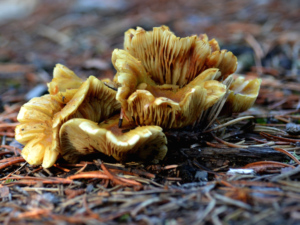 I found this colorful but solitary mushroom in mid-October on a well-travelled gravel pathway that was covered with jack pine needles. Several parts of it were growing from a single spot on the ground and the stalks were either very short or non-existent. The bright yellow-brown color was particularily attractive and the gills were of the same general color as the outer edges of the recessed wavy cap. The center of the cap had a darker brown color to it. The gills appeared to be either decurrent or notched and as if they had been nibbled on by perhaps either a snail or a slug. Each cap was 2 to 3" wide and of the approximate same height.
 I found this small, thin and fragile mushroom growing in lawn grass in early to mid July. The closest resemblence would be honey mushrooms but they don't appear until the autumn. It was about 2 or 3 inches tall, perhaps 1.5 inches wide and had a very thin, flat cap that is tattered around the edges. There is no veil on the stalk that is darker than the cap. This photo was taken at least 5 years ago and I've never seen another similar mushroom since. Edibility is unknown.
Early (May and June)
 Ganoderma applanatum (Artist's Conk) are common and widespread and can be found growing on living hardwood trees, reaching 50 cm. in length by 30 cm. wide. Growth stripes can vary from gray/black to light/dark brown. The texture is smooth on both the top and bottom of the brackets. As with all bracket fungi, it is considered to be inedible.
 Gyromitra esculenta (False Morel) grow up to 20-25 cm. tall with deep red/brown heads up to 8-10 cm. wide, wrinkled and appearing brain-like. Light tan to pale yellow hollow stalks. Found on the ground in early spring in both deciduous and coniferous forests. Poisonous, deadly fatal if consumed raw.
 Ptychoverpa bohemica (Wrinkled Thimble Cap) have yellow-brown to dark brown caps that are broadly conical and can be 5 cm. tall by 5 cm. wide. It also appears brain-like and has tight verticle wrinkles and the bottom edges are free from the stalk. The fragile and crumbly 3 to 7 cm. tall stalks are off-white to yellow to ochre on the outside and white and hollow on the inside. It is a common spring mushroom that can be found growing as singles or in small patches on the ground in mixed woods and clearings before the deciduous leaves fully develop. Edible.
 Morchella esculenta (Yellow Morel) can be up to 15 cm. tall and broadly conical, pale to yellow-brown, honeycombed with well-defined irregularly shaped pits. The white to cream stalks are delicate, rough and widest near the base. Widespread and quite common, they can be found on the ground in spring, usually in charred areas after forest fires and more predominant under jack pines. Edible.
 Peziza praetervisa are cup-shaped, thin and brittle but become flattened with a wavy edge with age. The inside edge is purplish-brown to brown with age and the outside is similar but paler. It is a common fungi that fruits in clusters among charred wood such as firepits or after forest fires in early spring. Edibility is unknown.
 Trichaptum abietinum is a small, thin, white bracket fungus, that is shelving and overlapping. It is 2 to 3 cm. long by 1 to 1.5 cm. wide, tough and velvety, white to creamy gray and very slightly zonate. The underside is brown to ocher. Widespread and common, it can be found on dead conifers, mainly spruce. As with all bracket fungi, it is considered to be inedible.
 Albatrellus ovinus (Sheep Polypore) are 5-15 cm. wide, irregular-circular and flat to slightly depressed. They feel smooth and dry with cracks that are soft but becoming tougher as they age. Very common and found on both dead deciduous (maples) and conifers. Edibility is unknown.
 Polyporus mori have fan- to kidney-shaped caps that are up to 8 cm. wide and less than 1 cm. thick with wavy (scalloped) edges. With a wide color range of yellow to brick red, the texture could also vary from smooth to scaly. A very common bracket fungus, it's found on dead deciduous trees and branches early in the year. As with all bracket fungi, it is considered to be inedible.
 Cortinarius corrugatus is a common mushroom found in deciduous or mixed deciduous forests in late May and June. The cap is 5 to 10 cm. wide, slightly bell-shaped to convex, wrinkled and tan to light brown in color. Gills are rusty red to brown and wide-spaced. The stalk is 1.5 wide X 10 to 12 cm. tall, greenish- to tan-yellow and occasionally vertically veined. The base of the stem is slightly bulbous in nature. Edibility is unknown.
 Neolentinus ponderosus (Giant Sawgill) is quite common in western North America but is extremely rare in Ontario. It is a very large mushroom with convex caps of 5-30 cm. to broadly convex with age. It is buff to pinkish-colored with large brownish appressed scales and an inrolled margin when young. The attached gills are white to orangish-white with serrated edges, hence the origin of the English name for this fungi. The white to buff stems are 3-10 cm. long by 2-5 cm. wide with a slightly swollen base, dry, finely scaled or laterally ridged, with scales becoming reddish-brown towards the base, without a ring and tough. It can be found on barkless pine logs and stumps in bright sunlight early in the year, particularly in dry, warm spells. The overall odor is absent to slightly fragrant and it is edible, when young.
 Fuligo septica appears as a cake-like mass or as gobs of spray styrofoam from an aerosol can that is used as a crack filler around doors and windows. It is bright yellow with a brittle and smooth skin. It can be up to 20 to 25 cm. long by 2 to 3 cm. thick. A common fungi of the slime mould family, it is usually found on very decomposed logs and stumps in late spring or early summer. Unofficial common names for this attractive fungi are scrambled eggs or dog vomit. Edibility is unknown.
 Fomitopsis pinicola (Red-Banded polypore) is a bracket fungi up to 40 cm. long by 25 cm. wide and 15 cm. thick. This example is a very young one and much smaller than this. It is concentrically grooved, yellowish to orange-red to black as it ages. It appears to be varnished or resin-coated. It is a very common fungi found on rotting logs and stumps with a preference for spruce. As with all bracket fungi, it is considered to be inedible.
 Russula fragilis have convex to flat or slightly depressed caps that are 2 to 5 cm. wide, purplish to rosy, thin and slippery when wet. They also have a rough striate margin over white, close and attached gills.White and smooth stalks are 5 cm. tall by 1 cm. wide. It is a common spring fungus found on the forest floor. Edibility is unknown.
Mid Summer (July & August)
 Galerina paludosa are small fungi with 1 to 3 cm. caps, conical or bell-shaped, knobbed, smooth and tan. The close gills are attached and also tan. Stalks can be up to 12 cm. tall, slender and coated with white patches in intervals. It is commonly found in mossy bogs of cedar early in the year. Edibility is unknown.
 Pleurotus ostreatus (Oyster mushroom) is a large white mushroom with caps of 5 to 20 cm. wide that range from convex to flat and are often shelved. It is moist, smooth and thick and has well-spaced decurrent gills. The short and thick white stalk, when present is hairy near the base but is often lacking. A common mushroom, it can be found on dead logs, stumps and standing trees in early July. Edible
 Geoglossum difforme (Common Earth Tongue) can grow up to 10 cm. (4 inches) tall and are clavate (club shaped), flattened and black in color. They can be sticky or slimy when wet and rubbery when dry. They usually grow as individuals on well-rotted or moss covered logs but will occassionally be seen in groups of up to 8 or 10 stems. Edibility is unknown.
 Conocybe lactea (Dunce Cap) are very common in lawns in early summer. Caps are up to 3 cm. wide and are bell-shaped or conical, hence the name and are smooth to radically wrinkled. Colors can vary from tan to cream or near white. Stems are thin and up to 10 cm. tall and appear as slightly scaled or hairy. Edibility is unknown.
 The Hygrocybe miniata (Vermilion Waxcap) is a common and widespread mushroom found on the ground in woods and dry marshy areas. It is up to 3 cm. wide and 7 or 8 cm. tall with the convex cap, gills and stem being all the same bright red color that can change to orange then to yellow as it ages. Edibility is unknown.
 Hygrocybe cantharellus (Chanterelle Waxcap) is a brilliant orange mushroom with the cap fading to orange and yellow. Tall and thin (8 cm.) with a 3 cm. wide flat cap that is dry to the touch. Found on the ground in moist conditions, it can grow as a single mushroom or in groups of 10 to 15. Edibility is unknown.
 Hygrocybe flavescens (Yellow Waxcap) is a very common, bright yellow mushroom of mid to late summer that can range from 2 to 6 or 7 cm. wide and has a convex cap with a faintly striated edge. The cap is slippery when moist and shiny when dry. Gills range from free to slightly attached. Stalks are up to 7 or 8 cm. tall by 1 cm. wide, and a lighter shade of yellow. It grows on both the ground in woods and in sphagnum moss. Edible, but not recommended, as it can easily be mistaken for poisonous mushrooms that appear quite similar.
 Hygrophorus chrysodon (Golden Tooth Waxcap) has a convex cap that is slippery when wet and stays shiny when dry. The cap has tiny bright yellow dots which are more prevalent closer to the edges. Gills are pure white and well-spaced. Both the caps and the stems can be up to 6 or 7 cm. An overall rare mushroom that is edible, but not recommended, as it can easily be mistaken for poisonous mushrooms that appear quite similar.
 Coltricia perennis is a stalked bracket fungus up to 10 cm. wide and only 5 mm. thick that can be flat to depressed or funnel-shaped and similar to velvet to the touch. The concentric zones vary from golden-yellow to medium or cinnamon brown bands. The stalks are up to 5 cm. tall by 1 cm. wide, hairy and colored as the cap. A common fungi, it is found in sandy soils under connifers or along the sides of trails. As with all bracket fungi, it is considered to be inedible.
 Tremella concrescens are gelatinous bodies that look like masses of slimy eggs which can vary in color from white to yellow with age and grow from the ground up as they envelop living stems of weeds and grasses. It is quite common in mid-summer after long wet periods. Edibility is unknown.
 Coprinus disseminatus (Crumble Cap) have conical to bell-shaped striated caps that are 0.5 to 1 cm. wide and are dry and blue-grey to grey-brown. Gills are attached and white. Stalks are up to 4 cm. tall, slender, white and slightly hairy and become smooth with age. A widely common fungi, it can be found on very decayed wood on the ground in August. Edibility is unknown.
 Clavulina amethystina (Amethyst Coral Fungus) is a unique purple coral fungi that grows in spagnum moss and is 6 to 8 cm. tall by up to 5 cm. wide and can be found in mixed coniferous and deciduous forests. Edibility is unknown.
 Amanita flavoconia (Yellow Patches) has a 2 to 8 cm. cap that is convex to flat, bright yellow to orange/yellow with scattered bright yellow patches. Gills are free and white to slight yellow. Stalks are pale yellow and up to 12 cm. by 12 mm. with a bulbous base. The ring is persistant and cream to yellow. A very common mushroom, it grows on the ground in late August and early September in both coniferous and deciduous woods. Edibility is unknown but since it is an Amanita, it is best to consider it as poisonous.
 Amanita muscaria (Fly Agaric) A very attractive and common mushroom which is unusually large. Caps are up to 20 cm. wide and the scaly 2 cm. wide stalks can reach almost the same height. The yellow cap is loosely covered in soft patches ranging from white to tan above white gills. Found on the ground in both deciduous and coniferous forests. Poisonous.
 Nolanea quadrata (Salmon-Colored Nolanea) A small colorful mushroom with pointed caps 2-4 cm. wide that feel dry and smooth. Matching colored stalks are 6-8 cm. high. Very common, it is found on the ground in mixed forests. Poisonous.
 Marasmius androsaceus is a small delicate mushroom with 5-12 mm. caps, domed to flat to depressed with age. They are smooth, radially striate (grooved), and pinkish- to red-brown and paler to almost white at the edges. Gills are wide, attached and flesh-colored. Tall, narrow stalks of 8 cm. are tough, smooth and shiny black in color. A very common mushroom, it grows in groups in mixed forests in mid summer. Photo credit, Jennifer T. Edibility is unknown.
 Boletus badius (Bay-Brown Bolete) have very rusty brown convex caps that are slippery when wet, smooth and up to 11 cm. wide. An identifying characteristic is the yellowish to white flesh that stains blue before fading. Tubes are yellow to yellow-green. The curved stalks are 10 cm. high and up to 2.5 cm. wide and colored like the cap. It can be found on rotting conifer stumps in late August and September. Edible.
 Hygrocybe marginata (Orange-Gill Waxcap) have caps of 2-5 cm. across, that start as conical to bell-shaped and becoming convex to flat, broadly knobbed and smooth. They are bright orange, fading to yellow, starting at the margin (as seen here). Ther gills are also bright orange and attached to decurrent. The stalks can be up to 8 cm. by 6 mm. wide, smooth and colored as the cap. Widespread but uncommon, it is found on the ground in wet, mossy areas in August. Edibility is unknown.
 Coprinus atramentarius (Tippler's Bane) A common mushroom that is a member of the "ink caps" with cone-shaped caps that are up to 8 cm. wide, brownish-grey and smooth to the touch. As it ages, the gills become black, as does the edges of the caps and they turn into an inky fluid. At 15-20 cm. in height, it grows in grassy areas, usually on buried decaying wood. The English name is derived from the fact that if you consume this mushroom with any alcoholic beverages, you will immediately be sick to your stomach. However, they must be eaten the same day they are harvested. Edible, with caution.
 Pholiota flammans (Flaming Pholiota) have caps of 4 to 8 cm. that start as convex and becoming flat with age and are dry. They are covered with yellow cottony scales and are a vibrant golden-yellow to orange-yellow in both the cap and stalk. Gills are broadly attached, close and yellow also. Stalks can be up to 10 cm. tall by 1 cm. wide. They are widespread but not a common mushroom found on decaying logs and stumps in late August and early September. Edibility is unknown.
 Cladonia Verticillata (Ladder Lichen) Although this is a lichen and not a mushroom, I have included it in here as it is common among other fungi in the autumn. At 1 to 2" (2 to 5 cm.), these lichens grow in very shallow soil conditions or even in a few pine needles over barren rock. Brittle and crumbly in dry weather, they readily absorb any moisture from dews or rains and flex easily. Occasionally, other lichens can be found growing out of the top of the cup on the one below it, hence the name of ladder lichen. This photo was taken in late August. Edibility is unknown.
 Rozites caperata (The Gypsy) have caps of 5 to 10 cm., convex to flat or occasionally knobbed that are straw-colored, dry and with radial wrinkles. The gills are white to tan and attached, becoming rust-brown with age. Stalksd can be 12 by 2 cm. smooth, slightly fibrilose and whitish. The ring is white and persistent. It is a very common mushroom found on the ground in forests in late August. Edible.
Autumn Favorites (September and October)
 Russula olivacea are large mushrooms with 10 to 20 cm. caps starting as convex then becoming flat with a central depression. The color also changes from olive-brown to red to purple-brown. The attached gills start as cream and change to ochre. Stalks can be 10 cm. tall by up to 3.5 cm. wide and are white, tinged in pink. It is common and can be found on the ground under a variety of hardwoods, especially beech or oak in September. Edible.
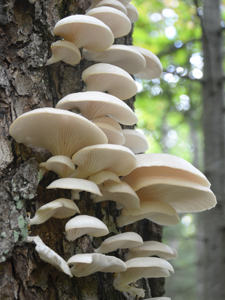 Pleurotus dryinus are white to light yellow, 5-20 cm. wide with a flat to slightly convex cap with a depressed center. They are dry and smoothly soft with edges that are often rolled inwards, growing singularly or shelving. Gills are decurrent, colored as the cap and well-separated. Short thick stalks are of the same color and off-center. Widespread but not plentiful, they grow on a variety of decayed hardwood stumps and roots. Edible.
 Hebeloma crustuliniforme (Poison Pie) Caps are 3-6 cm. wide, are slightly convex to flat and are dry to slippery when wet with a light brown color, often speckled darker. Hairy, thin white stalks can be up to 15 cm. tall. Widespread and fairly common, it grows on the ground in open woods. As the English names says, you just know this mushroom is Poisonous.
 Piptoporus betulinus (Birch Polypore) is a bracket fungus that can grow to 25 cm. wide, about half that in length and up to 6 or 8 cm. thick. The color varies from a dirty brown (here) to grey and is usually smooth but is occasionally rough textured or scaly. The underside is smooth &white and easily scratched. Widespread and common on both standing and fallen dead birch. As with all bracket fungi, it is considered to be inedible.
 Fomes fomentarius (Tinder Polypore) are bracket fungi up to 15 cm. wide and resembles hooves that are as high as they are wide. Colors vary from light gray (as seen here) to browns to charcoal grays. A very common fungi, it is found on both standing and fallen deciduous logs. As with all bracket fungi, it is considered to be inedible.
 Trichaptum biforme (Purple-toothed Polypore) are shelving and overlapping, flat to slightly convex, 2 to 8 cm. long by 2 to 6 cm. wide. They are thin, tough, velvety and narrowly zonate. They vary from white to cream to ochre becoming grey in age. A very common fungi, they can be found on decaying deciduous wood. As with all bracket fungi, it is considered to be inedible.
 Gymnopus acervatus (Clustered Collybia) is easily identified by its cluster of 3-5 cm. wide caps that are slightly conical, dry, smooth and reddish-brown with light tan edges. Tall (8 cm.), hollow stalks are dark in color. Widespread and quite common, it is found on the ground in subdued light with humid conditions on very rotten wood that is often covered with moss. Edibility is unknown.
 Pluteus admirabilis is a bright yellow mushroom that is 1 to 3.5 cm. wide, convex, becoming flat, knobbed to depressed, thin, smooth, dry and wrinkled towards the center with a striate margin. Gills are free, close, fragile and turn from whitish to yellow (as seen here) to rosy. The stalks are up to 5 cm. tall by 4 mm. wide, smooth, yellow and have a white cottony base. A very common mushroom, it can be found on well rotted mossy wood in early September. Edibility is unknown.
 Dacrymyces palmatus (Orange Jelly) is a unique fungi that is yellow to orange, soft and slimy gelatinous, spatulate. With age, it becomes lobed or multi-lobed and finally convoluted. It can vary widely in size but rarely exceeds 5 or 6 cm. long by 2 or 3 cm. in height. It is quite common in the early fall and can be found on dead conifer stumps and logs after prolonged rainy periods. Edibility is unknown.
 Lycoperdon perlatum (Gem-Studded Puffball) are spiny small globes (5-6 cm.) usually found in clusters and aging to yellow-brown to brown when the skin cracks to release olive spores. Widespread and common on woody debris. Edible when white, although they are basically tasteless.
 Lycoperdon curtisii (Curtis's Puffball) are up to 2 cm., have prominent spikes and turn from white to brown with age. They are a very common puffball which grow in small clusters and can be found in both grassy areas as well as gravel lanes. Edibility is unknown.
 Calvatia excipuliformis (Pestle-Shaped Puffball) can grow as large as 15 cm. tall and 10 cm. in diameter. Changing from white to brown with age, they will develop wrinkles where the stalk and head meet as they age. The head will crack in an irregular pattern to release the spores. Edible when young.
 Cortinarius cortinitus is a small attractive mushroom with 3-7 cm. rich brown caps that are convex to broader convex and very slippery when wet. The close attached gills appear slightly violet in color when young before turning reddish brown with age.The 2 cm. by 10 cm. white stalks have a distinctive rusty brown pattern near the base and they are also slimy when wet. It is a common early fall species found on ther ground in shady areas. Edibility is unknown.
 Suillus granulatus (Granular-Dotted Bolete) have smooth & slimy convex caps up to 13 cm. wide that vary from tan to medium brown when young and age to stained white. The tubes are a dull white to light yellow. Stalks occassionally grow to 8 or 9 cm. by 2 to 3 cm. wide, are white and can have brown dots in the upper half. They can be found under pines or spruces in early fall and are edible.
 Boletus edulis (King Bolete) is a very large mushroom with a medium brown smooth cap up to 20 cm. in width that is slippery when wet and sticky when dry. Young tubes are white, turning to off-yellow (as seen here) and then yellow-green with age. The tan to light yellow stalk can easily reach 15 cm. high by 2 to 3 cm. wide and has a bulbous base and streaked grainy lines on it. It is found under conifers and has a relatively short life but is edible when young.
 Suillus spraguei (Painted Bolete) is bright dark pink to red mushroom with a 5-10 cm. cap that is slightly convex and dry to the touch and light yellow below the reddish scales. The large tubes are of the same yellow color. The scaly stalk is of the same reddish color and is 7-8 cm. tall by 1.5 cm. wide and the ring is persistent. It can be found in the early fall under white pines in a mixed shady forest and is edible.
 Suillus luteus (Slippery Jack) is a very common early fall mushroom with a slimy smooth convex 5 to 10 cm. cap that varies from yellow- to red-brown and has light yellow tubes. A distinguishing feature of the short thick stalk (10 X 2.5 cm.) is its pure white color and a persistent dark ring that is prominent and flared. It can be found under conifers and is definitely edible.
 Suillus salmonicolor (Slippery Jill) is a short mushroom of 5 to 10 cm. in circumfrence with a slightly convex cap that is extremely slimy and is yellow-brown to reddish-brown. When broken, it is a slight yellow with very small pores. Stalks can reach 7 cm. by 1 cm. wide and evenly covered with small dark brown spots, both above and below the collapsing/disappearing ring. It is comomly found under white pines or other conifers and is definitely edible.
 Suillus placidus has an ivory-white cap or a slight yellowish tinge that is 3 to 10 cm. across, convex, becoming flat, smooth, slimy when wet and shiny when dry. Stalks are up to 12 cm. tall by 2 cm. wide with wine colored blotches. It is usually found under white pines in early fall and is edible.
 Suillus sinuspaulianus have a rich coffee-brown convex cap up to 12 cm. in width that fades to a fiber-streaked orange-brown with age. The large light yellow pores are simnilar in color to the flesh. The thick stalk is 3 cm. wide by 10-12 cm. tall and is lighter brown with a prominent dark ring. It is very common and found under conifers in early fall and is edible.
 Tylopilus chromapes has a large 6-12 cm. convex to flat cap that can vary from pinkish-red to light purple to tan and is dry and smooth. The tubes on this bolete are white when young and change to flesh-colored to brown with age. The thick stalks are 10 cm. tall by 2 cm. wide and are conspiculously colored with a bright yellow base, small red dots in the mid section and solid reddish brown just under the cap. It can be found in early fall in mixed forests, usually in damp shady mossy areas. Edible.
 Cantharellula umbonata (Grayling) is a small mushroom up to 4 cm. wide and 8 cm. tall. It starts as convex but changes to flat then to depressed with a small central knob. The cap is dry, smooth and the silvery grey color is a distinguishing factor of this common mushroom that grows in moss in early fall. Edibility is unknown.
 Leccinum holopus is a bolete with 3 to 10 cm. wide off-white to pale grey convex caps. Stalks are up to 12 cm. tall by 2 cm. wide and dotted with dark brown tuffs. It can be found on the ground in wet spots in mid to late summer. Edible.
 Leccinum insigne is a very common bolete mushroom found under poplars and pines across the northern arboreal forests in early fall. It is up to 20 cm. wide, convex and dry. The cap is a light tan in color. The tubes vary from off-white to gray. The stalk can also be up to 20 cm. tall and is whitish with tiny,dark raised dark spots. Edible.
 Gymnopus dryophilus (Oak Collybia) have 2 to 6 cm. caps that are convex to flat, thin and dry, often with a wavy margin and vary from tan to reddish-brown that fades with age. Narrow, white gills are crowded and attached. Stalks can be up to 6 cm. tall, flattened, hollow and red-brown to tan. A very common mushroom, it is found under conifers or hardwoods in the fall. It is also known as Collybia drophila. Edibility is unknown.
 Hydnum repandum (Hedgehog mushroom) is a tooth fungi with a 3 to 10 cm. cap that is convex to flat, buff to orange-tan and smooth. It is often uneven with a wavy edge. Spines are fragile and up to 6 mm. long. The short stalks can be up to 2.5 cm. wide and are white to tan-buff. It is a common mushroom growing on the ground in mixed woods in September. Edible.
 Stereum ostra (False Turkey Tail) are shelving, overlapping and up to 8 cm. wide by 5 cm. deep. They are thin and have radically arranged silky hairs and are zonate. They are a beautiful light yellow to wood- or cinammon-brown in color with the lighter yellow and darker lilac colors showing in the recent year's growth. As one of the few bracket fungi that lacks pores on the underside, it is commonly found on dead wood in the fall. As with all bracket fungi, it is considered to be inedible.
 Hydnum umbilicatum is very similar to the hedgehog above except that it never exceeds 5 cm. in width so it is considerably smaller.The caps also have a deep depression which can form a hole. It is flat to convex, buff to orangeish-tan, smooth and with a wavy edge. The teeth, or spines, are tan colored, fragile and up to 6 mm. long. The stalks are colored as the cap. It is fairly common in the late fall (October) and found on the ground under conifers. Edible.
 Polyporus radicatus (Rooting polypore) is a stalked bracket fungi with caps up to 20 cm. wide by 1 cm. thick, convex to depressed. The color varies from yellowish to smokey-brown and is tough. Stalks are long, scruffy and rooting. A commom fungi found on the ground near rotting stumps in September. As with all bracket fungi, it is considered to be inedible.
 Pseudoarmillariella ectypoides has a 3 to 6 cm. umbilicate to funnel-shaped cap that is dry, thin and greyish to yellow-buff in color. It is radically striated with darker fibrils and tiny blackish scales. The yellowish gills are decurrent, narrow and well-spaced. The 6 cm. stalks are slender and of the same or lighter color as the cap. An uncommon mushroom, it is found on rotting conifer logs in early September. Edibility is unknown.
 Tremellodendron pallidum (False Coral Fungus) consists of clusters of very tightly packed branches about 10 to 15 cm. wide by 10 cm. high. They are tough, dry, flattened and off- or dirty-white to cream in color. It can be found under deciduous trees in early September. Edibility is unknown.
 Ramaria formosa (Pink-Tipped Coral) are densely packed golden-yellow to ochre branches that are 10 to 15 cm. tall and wide. They age and fade quickly at maturity to a drab brown with a thick whitish stalk. It can be found on the ground in mixed woods in the fall. Poisonous.
 Ramaria aurea (Golden Coral) are 7 to 15 cm. tall and 10 to 15 cm. wide with densely branched, thick white stalks for bases. They are golden-yellow to ochre, fading to a drab brown with age. It is common and can be found on the fround in mixed forests in the fall. Note the similar appearance to the pink-tipped coral above but this one is one of several similar species of yellow and orange corals that are difficult to tell apart, many of which have not had their edibility determine so none can be labelled as such.
Edibility is unknown.
Ramaria aurea (Golden Coral) are 7 to 15 cm. tall and 10 to 15 cm. wide with densely branched, thick white stalks for bases. They are golden-yellow to ochre, fading to a drab brown with age. It is common and can be found on the fround in mixed forests in the fall. Note the similar appearance to the pink-tipped coral above but this one is one of several similar species of yellow and orange corals that are difficult to tell apart, many of which have not had their edibility determine so none can be labelled as such.
Edibility is unknown.
 Megacollybia platyphylla have caps of 6 to 20 cm. wide becoming flat to depressed with age. They are broadly knobbed, and can be moist to dry, powdery or smooth with the margin splitting with age, turning blackish-brown to grey-brown or even pink-brown with darker fibrils. Flesh is thin and white with attached white gills that are broad and close to well-spaced. Stalks are 15 by 2 cm., white and streaked. A common mushroom in early September, it is found on logs and stumps. Edibility is unknown.
 Helvella lacunosa (Black Elfin Saddle) is a sac fungus. The fruit bodies (apothecia) can reach 15 cm. high and the cap is flat black to dull grey. The fluted (lacunose) stalks vary from off-white to smokey gray. It is a common fungi found on the ground in both lawns and woods in early fall. Edible.
 Hygrocybe virginea are small dry white mushrooms up to 4 cm. across and 7 cm. tall. The caps are convex to flat and centrally depressed with age. Gills are decurrent, wide and white. It is a common mushroom found in damp spots, usually moss, in the early fall. Edibility is unknown.
 Amanita albocreata has a conical 3 to 10 cm. cap becoming flat with age. It is white to pale yellow near the center and has small patches of the white to cream universal veil scattered over the cap. Stalks are 15 cm. tall by 1.5 cm. wide with a larger globulose base. Ring is absent and the cup is not obvious. An uncommon mushroom, it can be found on the ground in mixed forests in mid September. Edibility is unknown. Being an Amanita, it is best to avoid it as most of this class are poisonous to deadly.
 Amanita farinosa has a 2-8 cm. cap that is convex to almost flat with striated edges and grayish brown powdered remnants of the veil. Gills are white, close and free. The off-white stalk is 7 cm. tall and it also has the same grayish brown remnants of the ring. Although it isn't a common mushroom, it can be found on the ground in mixed forests in early fall. Edibility is unknown. Being an Amanita, it is best to avoid it as most of this class are poisonous to deadly.
 Amanita virosa (Destroying Angel) is a beautiful pure white mushroom in all of its parts. The cap of 5 to 12 cm. is convex to flat, slippery when wet and very smooth. Gills are close and free. The smooth to fibrose stalk can be up to 15 cm. by 2 cm. and has a noticeably swollen base and a large floppy ring. It is a very common mushroom found on forest floors in early fall. Don't allow the innocent white color fool you; it is one of the deadliest mushrooms in Ontario. Poisonous.
 Amanita bisporigera is very similar to the Destroying Angel (above) but can be distinguished by its central knob in the cap and a larger ring on the stalk. Gills are close and free. The cap, gills and stalk are all pure white. It can be 6 to 15 cm. tall with a 15 cm. stalk that is also 2 to 3 cm. wide. It is fairly common in late August through mid September. It is also deadly poisonous.
 Russula laurocerasi is a large mushroom with a 15 cm. wide convex cap that can be depressed in the center. It is a dull yellow, slimy when wet and has a noticeably grooved margin. Gills are attached, close and off-white to dull yellow. The stalk is 10 cm. by 3 cm., dirty white and aging brownish in color. A common mushroom, it is found on the ground under hardwoods in early fall. Edibility is unknown.
 Russula aeruginea have a dirty gray to dull olive green cap of 5 to 15 cm. wide that varies from slightly convex to flat to depressed that is powdery to velvety and slippery when wet. Stralks are up to 8 cm. tall by 2 cm. wide and are white to yellowish green and smooth. Gills are attached, close and white to cream colored. Commonly found on the ground in early to mid August, they are edible.
 Russula paludosa is a large mushroom with a convex cap that becomes deeply depressed with age. The bright orange-red color when young changes to orange with age and is smooth and slimy when wet. Gills are attached, wide and pure white but change to off-white with age. Stalks can reach 10 cm. by 3 cm., white and smooth. It is common and usually found in damp moss under conifers in early fall. Edible.
 Russula claroflava (Yellow Swamp Russula) has a 4-10 cm. convex golden yellow cap that becomes flat to slightly depressed with age. It is smooth and becomes slippery when wet. Gills are free and also yellow. The stalk can reach 8 cm. by 2 cm. and is white and smooth. It is commonly found in wet spots under birches or mixed woods in the early fall. Edible. Of these last three Russulas, the grey one has the most robust flavor but is not as common to locate. The red one has great flavor and is very plentiful. The yellow one is the rarest of the three to locate and the flavor is the least bright, but is still good. Edible.
 Hygrocybe punicea are bright red conical capped mushrooms up to 6 cm. that are slippery when wet and become nearly flat with age. Gills are attached, wide and yellow to orange-red. The similarly colored young red stalk is up to 6 cm. tall by 12 mm. wide and fades to yellow and becomes hollow with age. It is common and can be found on the ground in early fall. Edibility is unknown.
 Xeromphalina cauticinalis are tiny mushrooms with convex yellow- to orange-brown smooth caps from 5 to 25 mm. wide when young and becoming centrally depressed to umbilicate and radically striate with age. Gills are attached to slightly decurrent, well spaced, with cross veins. Stalks can reach 7 cm. in height, very slender, tough and yellow-brown to blackish-brown. They are found in clusters under conifers and on mossy logs in early fall. Edibility is unknown.
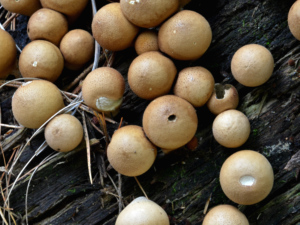 Lycoperdon pyriforme (Pear-shaped Puffballs) are up to 5 cm. tall by 3 cm. wide, pear-shaped and have a sterile base. They vary from white to tan to red-brown and are minutely rough at first but change to smooth and papery-skinned with age. This is the most common of all puffballs and can be found in dense clusters on rotting logs and stumps. Edible, but tasteless.
 Aleuria aurantia (Orange Peel) is a stemless sac fungus that is bright orange, thin & brittle and cup-shaped when young but becomes almost flat with a wavy edge as it ages. It is commonly found on bare or disturbed moist ground, trails or gravel roads in the early fall. Edible.
 Clavariadelphus ligula (Strap-shaped Coral) is a member of the coral fungi that can reach 7 cm. tall but only 3 to 12 mm. in width. It is tan to brown, unbranched and has a smooth to wrinkled surface. Clubs are flattened and often wider at the tip, or spatulate. A very common fungi, it can be found in clusters on the ground under conifers or in mixed woods in the early fall after rains. Edible.
 Hypomyces lactifluorum (Lobster Mushroom) is well named due to its bright orange-red color. As a parasite that attacks milk mushrooms, it will overtake its host and completely hide it in early fall. Oddly formed, 10-15 cm. wide, widespread and common, it is edible.
 Clitopilus prunulus (The Miller Mushroom) is a bone-white mushroom with a convex to flat to depressed cap varying from 2-10 cm. As it ages, it turns to cream-colored to buff or grayish. Short thick stalks are white with soft cottony surfaces. Widespread and common, it is found on the ground in both deciduous and coniferous woods. Edible.
 Oxyporus populinus is a broadly attached semi-circular bracket fungi up to 10 cm. wide that is white to cream-colored, smooth and often colored with green moss or algae. Widely common, it grows on living hardwoods, especially maple. As with all bracket fungi, it is considered to be inedible.
 Russula brevipes can either grow as a single mushroom or as in a cluster as seen here. Caps are 8 to 15 cm. wide and start as convex, then changing to flat and finally funnel-shaped as it ages. They are dry, smooth and white to light brown. Short thick stalks are also white and smooth to slightly hairy. A common mushroom, it grows on the ground in coniferous woods. Edible.
 Climacodon septentrionale (Shelving Tooth) is a combination of both a bracket fungi as well as a toothed fungi with several tiers that can each be up to 30 cm. wide, 12 cm. deep and 5 cm. thick. Growing in tight thick layers, it changes from white to light tan as it ages and is covered with matted hairs. This one was steadily dripping a pungent, clear yellowish liquid. Widespread and common, it thrives on the trunks of living hardwood maple trees. As with all bracket fungi, it is considered to be inedible.
 Rhodocollybia butyracea (Spotted Collybia) has a cap of 5-15 cm. and is convex, turning to flat with a wavy rim as it ages. It can be broadly knobbed, dry, smooth and with scattered flecks of rust. The tall thin stalk (15 cm.) is white and very brittle. A common mushroom, it is found on the ground in both coniferous and deciduous woods in thick decaying debris. Edible.
 Suillus americanus (White Pine Bolete) are small mushrooms with 3-10 cm. convex to flat, slimy caps that can have rust colored spots, especially near the rims. As with all boletes, the underside appears spongy instead of gilled. Sometimes called Butterball mushrooms, they are quite common and normally found under or near white pines, often in grass or lawns. Edible.
 Pluteus tomentosulus is a fairly large white musroom up to 7.5 cm. wide with a conical to bell-shaped cap that becomes flat and knobbed and can be tinged pinkish with age. It is usually cottony or woolish in appearance with free white gills that also become pinkish. Tall white stalks of 10 cm. by 8 mm. wide have a fuzzy surface. Not widely common, it grows on conifer wood in swampy or wet areas. Edibility is unknown.
 Lyophyllum decastes (Fried Chicken Mushroom) has a 5 to 15 cm. cap that is convex to flat and becoming depressed with an occasionally wavy outline. The cap color varies from grey- to smokey- to reddish-brown and the white to light beige gills are attached. Stalks range up to 7 cm. by 2.5 cm. and are white and smooth. It is a common fall mushroom found in mixed woods, parking lots and along trails. Edible.
 Armillaria mellea (Honey Mushroom) has a 3 to 10 cm. convex to flat cap before turing up with age.It can be dry to sticky and covered with scaly tufts near the center. The overall color is yellow- to rust-brown. Attached gills are close to well-spaced and whitish then colored as the cap with age. Ring is white, thick and flaring. It is a very common mushroom on rotten wood and stumps in the late fall. Edible.
 Boletellus chrysenteroides has a 2 to 10 cm. cap that is dry, hairy and rich- to olive-brown and has a mosiac or cracked surface pattern. Tubes are lemon-yellow. Stalks can be up to 12 cm. by 1.5 cm. and are brown with darker streaks. It is found in mixed woods in early to mid-September. Edible.
 Tricholomopsis decora has a very bright yellow 2 to 10 cm. cap when fully open that is convex to flat before becoming depressed with age. Gills are close and also yellow. Stalks are 6 cm. by 1 cm., yellowish and minutely hairy to scaly. Edibility is unknown.
 Cantharellus cibarius (Chanterelle) are dry, smooth and convex becoming flat then with a depressed center and wavy edges. They are 5 to 10 cm. wide with stalks up to 6 cm. tall and 2 cm. wide. They have a very distinctive yellow to orange-yellow color in the cap, stalk and gills which are decurrent, thick and often forked. They are a commom mushroom found on the forest floor in early to mid August. Highly sought after by restaurants, they are edible.
 Hygrophoropsis aurantiaca (False Chanterelle) has a convex cap of 2-6 cm. The rim appears in-rolled and the edges are paler than the orange colored center. The gills are orange to salmon in color. It can be found on mossy rotten logs or in thick layers of decayed pine duff. Edible, but can cause stomach problems in some people.
 Lepiota cristata is a small flat-topped white mushroom up to 5 cm. in width and height. It has a reddish-brown center that breaks into small scales towards the edges. The whitish and slightly pubescent stem has a large knob around the ring. It is common on the ground in forests and quite often in grasses close to forests in early autumn. Poisonous.
 Panaeolina foenisecii (Haymaker's Mushroom) have a bell-shaped cap and are 1 to 2.5 cm. wide and are greyish-brown to rusty brown with wide spaced darker brown gills. Thin beige stalks are up to 8 cm. long. They are the most common of the little brown mushrooms (LBMs) and usually grow in lawns in early autumn. Poisonous, but not deadly.
 Mycena rorida is a small autumn mushroom with caps of 5 to 10 mm diameter that can be broadly convex to flat with age, often with a central depression. The color is mostly white with pale brown fading to tan or ending up as yellowish-white. The upper cap is striated with a scalloped margin and dry to the touch. Gills are white and wide spaced. Identification is made easy by the slime-covered thin stalks of up to 5 cm growing in clusters under conifers. Common and wide spread. Edibility is unknown.
 Clitocybe gibba (Funnel Clitocybe) has a convex cap of 4 to 8 cm that becomes flat to depressed to funnel-shaped with age and is dry, smooth and tan to white. The pinkish tinge also fades with age. The decurrent gills are thin and white. Stalks are up to 8 cm tall and thin. A common mushroom found on the ground in woods, it is edible.
 Lactarius piperatus are big mushrooms up to 20 cm. wide and are convex, becoming flat and then funnel-shaped. They are off-white to cream-colored and dry. The cream-colored gills are attached and crowded. When broken, the "sap" resembles white latex paint and has a bitter taste. Short thick stalks, 8-9 cm. by 2 -3 cm., are also white to cream-colored like the cap. It is a common mushroom found in the fall under hardwoods. Edible, but bitter.
 Melanoleuca melaleuca has a cap of 4 to 8 cm.that starts as convex but ages to flat with a low dark knob. The cap itself is smooth, moist and of a smoky-yellow to light brown in color. Gills are close, white and attached. Tall white stalks of 8 cm. by 1 cm. have dark streaks. A very common mushroom often found in large groups in the fall in grassy or mossy places, it is edible.
 Russula decolorans have caps that are 5 to 12 cm. wide, convex to flat to slightly depressed, and are moist to dry and smooth. Color can vary from salmon-pink to orange-red with a darker center as they mature. Gills are white to yellow to ochre with age. Stalks can be up to 12 cm. tall and 2.5 cm. wide, smooth or wrinkled and white. A common mushroom found under conifers in early September, it is edible. Note: This is a very young example.
 Coprinus comatus (Shaggy Mane) are one of the latest appearing mushrooms in this area, just before the first frosts. Caps are 5-15 cm. across and usually taller in height than in diameter. Starting as light tan in color, they quickly change to grayish-white and become black and slimy around the rims as they age. As the name implies, they are covered with brown or gray upturned scales. It is the most well known member of the "ink caps". Widespread and very common, they can be found in grassy areas and disturbed soils such as on old abandoned logging roads. A very sweet and delicious mushroom, they are best harvested before turning dark as they are definitely edible.

 Cystoderma terrei is a very rusty brown capped mushroom up to 8 cm. wide and is convex then becoming flat with age. The cap appears leathery with orange-brown pointed scales. The white gills are attached but become free with age, as seen here. The stalk can be up to 6 cm. tall by 1 cm. wide. Not a common mushroom, it can be found on the ground under conifers. Edibility is unknown.
 Suillus brevipes (Short Stalked Bolete) are, as the name implies, short, 5-10 cm. wide and appear top heavy. The cap is convex, soft, smooth, slimy and light tan to rusty brown. The stalk is up to 5 cm. tall and 2 cm. wide and white to yellowish near the top. Very common in the decaying needles under both red and white pines, they are edible.
 Tricholoma pardinum appear as dome-shaped and bulky mushrooms that have caps of 5 to 15 cm. in width and stalks up to 12 cm. tall and 4 cm. wide. The streaked surface of the caps are dry and dirty gray in color with small darker gray or brown scales in the center. Not a common species, it can be found on the ground under conifer trees in the fall. Poisonous.
 Lepista nuda (Blewit) start with convex caps up to 12 cm. and become flat, then depressed and occasionally have a wavy rim. The color of the cap, gills and stalk can all range from faded purple to brownish. The stalk appears as fibrous and streaked. They are very common, have a pleasant odour and can be found on the ground in most woods in September. Edible.
 Lepista irina are large mushrooms of up to 15 cm. across, that are convex to flat with age, and have a wavy margin that is smooth & dry and becomes tan with age. Stalks are up to 10 cm. tall by 2 cm. wide, dry, white, fibrous-striate and also becomes tan with age. The attached gills are also flesh-colored to tan with age. It has a pleasant aroma at all ages. A common mushroom, it can be easily identified as growing in large fairy rings (this one was 30+ feet/10 meters) in mixed woods in early October. Edible.
 Russula emetica are often referred to as "red caps" and have caps of 5 to 10 cm. that are flat to slightly depressed. Slippery when wet and shiny when dry, they vary from rosy- to blood-red in color. Gills are free and white. Stalks can reach 7 cm. by 2 cm. and are also pure white and smooth. A very common mushroom, they are found on the ground on rotten wood. Poisonous.
 Ramariopsis Kunzei is a coral fungus of 2 to 6 cm. tall and is pure white, growing on an inconspicuous stalk with fragile curved branches of all the same width. A very common fungus, it is found on grassy or mossy areas in the forest in September. Edible.
 Psathyrella delineata is a very attractive but not common mushroom appearing in late September on well-rotted woody debris. The caps are 5 to 10 cm. wide, conical to bell-shaped, light brown with darker edges and evenly-scattered brown spots, dry and wrinkled near the center. The bright reddish brown color of young mushroom darkens as it matures then fades with old age. The gills are light brown, wide and attached. The stalks can be up to 10 cm. (4 inches) tall and 2 cm. wide and are whitish with darker bases. The ring disappears with age. Edibility is unknown.
Trichaptum biforme (Purple-Toothed Polypore) is a shelving and often overlapping bracket fungus of 2 to 8 cm. long by 2 to 6 cm. wide. It is thin, tough, velvety smooth and can be narrowly zonate. Young ones are white to cream in color and change to grey with age, as seen here. It is commonly found growing on rotting deciduous wood such as this birch log. As with all bracket fungi, it is considered to be inedible..
 Leucoagaricus naucina (Smooth Parasol) are up to 12 cm. wide, convex, dry, smooth and pure white. Stalks, also white, are up to 10 cm. tall by .5 cm wide with a swollen base and a noticeably movable ring. It is a common mushroom found growing on lawns and occassionally in woods in September. It is edible, but do so with extreme caution as it can easily be confused with the deadly Destroying Angel that also grows at that time of year and has an attached ring.
 Hygrocybe vitellina is a brilliant lemon-yellow small mushroom of only 1 to 4 cm. diameter with a convex cap becoming flat with age and a down-turned crimped rim that is bright yellow and dry. The yellow gills are attached to decurrent and very far apart. Stalks are smooth, thin, yellow and up to 6 cm. tall and found under conifers. It can be confused with a Nested Waxcap (below) which is wetter and slimy. Edibility is unknown.
 Hygrocybe nitida (Nested Waxcap) has an inrolled convex cap of 1 to 3 cm. that is slimy when wet, bright yellow, fading with age, and a striate margin. Gills are decurrent, bright yellow as the cap and far apart. Stalks are 7 cm. tall, 4 mm. wide, smooth, slimy and also yellow as the cap. It is a common mushroom found in moist mixed woods in September. Edibility is unknown.
 Cortinarius armillatus (Banded Cort) has a cap up to 12 cm.that is convex, moist, fiber-streaked and is rusty-brown to brick red. Gills are attached, close and of a less rusty color. Stalks are up to 15 cm. tall by 2 cm. wide, tan in color and with an obvious orange band. The base of the stalk is swollen and often clavate. It is a very common mushroom found in conifer forests. Edibility is unknown.
 Pholiota Squarrosoides has caps of 2 to 10 cm. ranging from convex to flat and are slimy when wet. Dense tan scales are located on a tan to white background that darkens with age, as seen here. Gills are attached and close. Stalks are up to 10 cm. long and scaly. Widespread and common, it grows in clusters on hardwood stumps or logs. Edible.
 Gymnopilus luteofolius have caps of 2 to 8 cm. wide, convex, becoming broadly knobbed with age. They are dry and reddish-brown around the edges and paler to yellowish in the center. The margin is inrolled and overhangs the attached and well-spaced gills that turn from yellowish to reddish-brown with age. Stalks are up to 10 cm. long and colored as the cap. Not a common mushroom, it can be found on rotting chips on the ground and on both vertical and flat logs. Poisonous.
 Paxillus involutus (Poisonous Paxillus) The flat to slightly depressed white cap can be from 5 to 15 cm. wide and has an inrolled margin that is dry and hairy in younger mushrooms and changes to smooth olive-brown as it ages. Gills are yellowish and decurrent. The thick stalk can be up to 10 cm. tall and 3 cm. wide and has the same color as the cap. It is common and widespread and grows on thick mulch in mixed forests. Poisonous.
 Gymnopilus sapineus have yellowish to brown caps of 3 to 9 cm. and are slightly hairy. Gills are close, attached and are light yellow becoming brown with age. Stalks are up to 8 cm. tall and are light tan above and darker near the ground where they are wider. This common species grows on dead conifers on or in the the ground in late September. Edibility is unknown.
 Hygrocybe acutoconica has a cap of 2 to 6 cm., conical to bell-shaped with a flaring upturned margin. It is very slimy, golden-yellow, and bright orange in the center. Gills are attached, yellow and wide spaced. Stalks are up to 6 cm. tall by 1 cm. wide. Although not common, it can be found on the ground in mixed forests. Edibility is unknown.
 Tylopilus eximius (Bitter Bolete) is a large mushroom with a cap of 8 to 25 cm. that is dry, smooth and tan to yellow-brown and aging to red-brown. Tan stalks are up to 15 cm. tall by 3 cm. wide, broader at the base and have a darker network pattern near the cap. It is found on the ground in September in mixed and conifer forests. As the name suggests, it is edible but bitter.
 Ramaria botrytis (Clustered Coral) is a coral fungi that can reach 7 to 15 cm. tall and 3 to 15 cm. wide under ideal conditions but is usually smaller. It is quite brittle and varies from light pink to pink or occasionally purple with wine-red brownish tips and appears similar to cauliflower. Not a common species, it can be found on the ground or in thick pine needles in the fall. Edible.
 Ramaria abietina is a yellowish-tan to light olive coral fungi up to 6 cm. tall by 2-4 cm. wide and has forked pointed tips. It is very common and can be found in dense masses under conifers in the fall. Edible, but bitter.
 Clavulina cristata (Cockscomb Coral) are up to 8 cm. tall, white and appear greyish or dirty as they age.They can turn black at the base due to a parasitic fungus. The branches are most often flattened and toothed. It is very common and can be found in late August and September on the ground in woody debris and thick moss. Edible.
 Hygrophorus fuligineus has a very slimy and wet blackish-brown to olive-brown cap of 3 to 10 cm. that is paler at the margin. Gills are broadly attached to slightly decurrent and far apart. The thick, white, slimy stalks are up to 10 cm. tall by 1.5 cm. wide. A common fungi, it is found on the ground in mixed woods. Edibility is unknown.
 Mycena haematopus have bell-shaped caps that are reddish-brown, smooth, striate and with a scalloped edge. The attached gills are whitish and staining red. The slender stalks are up to 8 cm. by 6 mm., smooth & fragile with a hairy base that is the same color as the cap. A common mushroom found in dense clusters in the fall on rotten wood.Edibility is unknown.
 Hypholoma capnoides has convex to flat caps from 2 to 7 cm. that is reddish-brown in the center and paler at the edges. The purple-brown veil remnants are attached to the edge, giving it a scruffy appearance. Gills are close, attached and white to that same purple-brown color with age. Stalks are up to 8 by 1 cm., white to tan and brown at the base. Edible.
 Stropharia aeruginosa (Blue-Green Stropharia) is a very distinctive mushroom that is 2-5 cm. wide, convex to flat and knobbed with age, slippery when wet and bright to dull blue-green that fades to yellowish with age. Gills are white to smokey, close and attached. Stalks are 7 by 1 cm. wide, white to blue-green and hollow. Not a common species, it is found on the grounds in conifer needles in the fall. Edibility is unknown.
 Hydnellum caeruluem (Blue Tooth) have violet-blue caps of 3 to 11 cm. when young, fading to white and aging to a dark brown. The velvety surface becomes pitted with age. Like the cap, the teeth start as bluish, then white and becoming dark brown with whitish tips with age. Stalks are up to 4 cm. tall by 2 cm. wide. Not a common fungi, it can be found under conifers in eaerly September. Edibility is unknown.
 Cortinarius iodes have 2-6 cm. caps that are bell-shaped to convex, slimy and purple before becoming paler with age. Gills are attached, close and purple to gray before aging to a cinnamon color. The stalks are 7 cm. tall by 1.5 cm. wide and also very slimy. It is commonly found under hardwoods in the fall. Edibility is unknown.
 Collybia tuberosa (Tuberous Collybia) is a dainty mushroom of 3 to 10 mm. width, convex to flat, smooth, dry, and whitish to pinkish-brown. Gills are attached or decurrent, narrow and white. The slender stalks are up to 2 cm. tall, smooth to powdery below, and white to tan. A common mushroom, it grows on old decayed mushrooms. Note the pine cone for a size comparison. Edibility is unknown.
 Cortinarius semisanguineus (Red-Gilled Cort) has a 2-7 cm. cap that can be convex or bell-shaped to flat or depressed that is dry, silky to scaly and dark yellow-brown. Gills are attached, close and red to cinnamon. Stalks are up to 8 cm. tall by 8 mm. wide and yellow-brown. It is commonly found in damp moss in mixed forests in the fall. Edibility is unknown.
 Gomphus floccosus (Woolly Chanterelle) are large trumpet-shaped mushrooms up to 15 cm. tall and 10 cm. wide, dry, with a slightly depressed scaly top that is yellowish to orange to reddish in color. The reddish-brown decurrent gills are poorly formed and consist of shallow wrinkles. The short stalks are pale yellow and blend into the cap. A fairly common mushroom in September, it can be found under conifers. Edible, but can cause gastrointestinal problems for some people.
 Craterellus cornucopioides (Horn of Plenty) are smokey-grey to almost black trumpet-shaped tubes of 5 to 12 cm. tall and up to 5 cm. wide. They are dry and smooth with an inrolled rim, thin and tough. Gills are absent. They are widespread and quite common in leaf and needle matter in early September. Edible.
 Hohenbuehella angustata are funnel-shaped fungi with 2 to 5 cm. wide caps in a variety of shapes from funnel to spatula-shaped and sometimes with an in-rolled edge. They can be shelving and are whiteish to light yellow to pinkish buff and have a gelatinous upper top layer. Gills are narrow and whitish becoming darker with age. Stalks are very short to absent. Not a common fungi, it can be found in late summer or early autumn on well-rotted stumps or logs, sometimes buried. Edible.
 Polyozellus multiplex have funnel-shaped caps of 1 to 5 cm. across, that are dry & smooth but with a wavy margin, an uneven surface and a pleasant odour. They can vary from dark purple to almost black. The grey gills are decurrent, shallow, far apart and have cross-veins that have a net-like arrangement. The smooth stalks are 1 to 4 cm. tall by 2.5 cm. wide, colored like the cap, solid and usually fused near the base. This rare species can be found late in the fall on the ground under conifers. Edible.
 Hygrocybe coccinea (Scarlet Hood) have 2 to 5 cm. caps that are conical to convex before becoming flat & knobbed and are smooth, dry and a dull vermillion color that fades to orange. The attached gills are red to peach turning yellow at the edges with age and are far apart. Stalks can grow to 4 cm. by 6 mm. and are yellow, tinged with red. This is a common mushroom that can be found under conifers late in the fall. Edible.
 Phaeolus schweinitzii (Dye Maker's Polypore) is a bracket fungus of up to 25 cm. wide by 3 cm. thick that is depressed and corky-tough. It starts as finely to coarsely hairy but becomes smooth with age and varies from golden to ochre or rusty to reddish brown and has a yellow margin. It is fairly common in the late fall and can be found growing on the ground from buried conifer roots or stumps. As with all bracket fungi, it is considered to be inedible.
 Spathularriopsis velutipes (Velvet-Stalked Fairy Fan) are up to 6 cm. tall with flattened heads that vary from pale yellow to dark brown and are darker than the cylindrical stalks. It can be found growing on well rotted-hardwood or under mixed forests on the ground in late fall. Edibility is unknown.
 Leotia lubrica (Green-Capped Jelly Baby) is a gelatinous fruitbody with a bright yellow stalk and an irregular lobed blackish-green head or cap that is up to 5 cm. tall and 1 to 2 cm. wide. It is fairly common and can be found in wet spots or on old moss-covered stumps in the late fall. Edibility is unknown.
 Polyporus umbellatus is a very large bracket fungus of up to 50 cm. wide and is globe-shaped like a cauliflower. It is made of several circular centrally attached caps arising from a strongly branched stalk. Each cap is up to 3 cm. wide, flat, thin, smooth and pale brown to ochre with age. It can be found on the ground in late fall usually close to hardwood stumps. Edibility is unknown.
 Tubaria confragosa are small mushrooms with 2 to 4 cm. caps that are convex to bell-shaped and vary from a red-brown to pale tan. The caps are covered with a white, flocose material that is thin & fragile and has a striate margin. The stalks are up to 5 cm. tall by 3 mm. wide and have a persistant ring when open. It is easily recognized by the fuzzy, white growth on the cap and stalk. Not a common fungus, it can be found on mossy stumps or logs in September. Edibility is unknown.
 Amanita citrina (False Death Cap) are 3 to 10 cm. wide, convex to flat, usually smooth but can have buff patches. The cap is pale greenish-yellow to yellow-white and the gills are free, close and white. The stalks are up to 12 cm. tall, 1.4 cm. wide, white and smooth or slightly fuzzy near the globe-like base. An easy identification is the large white persistent ring. It can be found on the forest floor in late summer. As with all Amanitas,it is best to consider it as poisonous.
 Bjerkandera adusta is an unmistakable shelving & overlapping bracket fungus with narrow 3 to 7 cm. long and 4 cm. wide brackets that are thin, pliable and velvety before turning a dirty white to grey or smoky brown with age. A very common species, it can be found on hardwood stumps and logs in late September. As with all bracket fungi, it is considered to be inedible.
 Lenzites betulina (Gilled Bracket) is a very thin and tough bracket fungi of up to 8 cm. long, 5 cm. wide and 2 cm. thick that forms in a semi-circular pattern, often wavy. The top is hairy with concentric colored bands of dark, light and rusty-orange browns. The white to creamy colored underside lacks the typical pores of most bracket fungi but has gills radiating from the point of attachment. It is commonly found on dead hardwood logs and stumps. As with all bracket fungi, it is considered to be inedible.
 Amanita rhopalopus have 5-18 cm. wide caps that are convex to flat or slightly depressed and are dry, white to creamy and covered with white warts. Gills are free, close and white. The white stalks can be 18 cm. tall by 2.5 cm. wide with an obvious basal bulb that is deep in the soil.The white ring is disappearing or attached to the cap. Not a common fungi, it can be found on the ground under conifers. The edibility is unknown but being an Amanita, it is best to consider it as poisonous.
 Cystoderma amianthinum have 2-4 cm. wide convex caps that are dry, powdery to granular orange-yellow with radial wrinkles near the edges. Gills are attached, close and white to cream. Stalks are up to 6 cm. tall and colored like the cap. The thin fragile ring can be attached to the cap margins. It is a common fall mushroom found on the ground in mixed forests. Edibility is unknown.
 Cortinarius cinnamoneus (Cinnamon Cort) have 2-5 cm. caps that vary from bell-shaped to convex, knobbed and are dry & silky and are a beautiful cinnamon-yellow color. Gills are attached, close and of the same rich color. The stalks are up to 8 cm. tall and 6 mm. wide and show more yellow. The ring is also of the same color as the stalk. It is very common and can be found in wet areas under connifers. Edibility is unknown.
 Tyromyces chioneus is a pure white common bracket fungus that is convex to flat and up to 10 cm. long by 8 cm. wide and 3 cm. thick. It is soft and finely hairy but becomes smooth with age. It can be found on dead wood that is damp and close to the ground. As with all bracket fungi, it is considered to be inedible.
 Trametes pubescens is a small, thin but tough, shelving bracket fungus that is up to 6 cm. long by 5 cm. wide and 0.5 cm. thick. It varies from cream to a yellow-tan color and the upper surface is smooth to finely hairy with a white underside. It is very common and can be found on dead hardwood branches but like all bracket fungi, it is considered to be inedible.
 Cantharellus tubaeformis have caps of 1-5 cm. that are convex to flat becoming funnel-shaped with age and have a wavy margin that is moist and olive to yellow-brown in color. They are then covered with very tiny dark brown scales. The gills are decurrent, quite far apart, narrow and ocher colored becoming grey. Stalks reach 6 cm. tall by 6 mm. wide, are smooth and yellow to ocher in color. It is a common mushroom that is easy to recognize from the color & wide spaced light gills and is found on moist ground in forests. Edible.
 Leotia lubrica (Common Jelly Baby) are gelatinous yellow to yellow-brown with age and up to 5 cm. tall with irregular 1 to 2 cm. lobed heads. The stalks are also gelatinous and colored as the cap. A common fungi, it can be found in September in dense clusters on the ground after wet periods. Edibility is
unknown.
Leotia lubrica (Common Jelly Baby) are gelatinous yellow to yellow-brown with age and up to 5 cm. tall with irregular 1 to 2 cm. lobed heads. The stalks are also gelatinous and colored as the cap. A common fungi, it can be found in September in dense clusters on the ground after wet periods. Edibility is
unknown.
 Tremiscus helvelloides (Apricot Jelly Fungus) is an irregular tongue-shaped to funnel-shaped fungi of 2 to 10 cm. tall by up to 6 cm. wide that is smooth, pale pink to apricot or red-brown in color and rubbery or gelatinous in texture. The stalks form part of the top. It is widespread & fairly common and grows under conifers on well rotted wood in wet periods in September. Edible, but lacking flavor.
 Limacella illinita have conical to bell-shaped caps of 2-7 cm. with a low knob that are slimy when wet smooth, white and with a tint of yellow near the center. Gills are free, white and close. The stalks are 8 cm. tall by 5 mm. wide, white and slimy. The ring disappears quickly. This mushroom is not common but can be found on the ground in deciduous forests. Edibility is unknown.
 Clitocybe clavipes (Club Foot) have caps of 2 to 8 cm. wide, convex to flat & depressed, broadly knobbed, smooth and smokey-brown to grey-brown. They are quite fragrant. The white to cream gills are decurrent and well-spaced. Stalks can be 7 cm. tall and enlarging down to a large clavate base (hence the name) and of similar color as the cap. It is widespread and very common and one of the most common Clitocybe spp. that is found under conifers in mixed woods in late September. Edibility is unknown.
 Exidia alba (White Jelly Fungus) can be up to 10 cm. wide, gelatanous, lobed or convoluted. They are often fused together like brain matter and are white turning to ivory sometimes tinged pinkish (here) or violet. Not common, they can be found on de-barked hardwood such as this white birch. Edibility is unknown.
 Clitocybe dealbata have dry, smooth white caps of 1-4 cm. that are convex with an inrolled margin. With age, the cap becomes flat, with a wavy margin that is sometimes depressed and will be thin, gray-brown when wet but drying white. Gills are attached, narrow and white. Stalks are 3 cm. by 1 cm. white, tough and powdery and colored as the cap. Not common, it will be found in or very close to grass in late September. Very poisonous.
 Clitocybe odora (Anise-scented Clitocybe) have 3-8 cm. convex caps becoming flat with a broad knob and are dry & smooth, light-colored grey-green to blue-green. They have a fragrant odor of anise or licorice. The gills are attached to decurrent, close and white to buff. Stalks grow to 8 cm. tall by 1 cm. wide, white and cottony at the base. Not a common species, it can be found on the ground in September. Edible.
 Albatrellus confluens are up to 12 cm. across and 3 cm. thick, flat or slightly depressed in the center and almost circular. The lobed or even margin is fleshy-soft, creamy-yellow to tan. The caps are often fused together at the edges. Stalks up to 8 cm. tall by 2 cm. wide are tapered towards the base and both them and the pores are cream to white. A common fungi, it can be found on the ground under conifers. As with all bracket fungi, it is considered to be inedible.
 Marasmius rotula (Horsehair Mushroom) is a tiny little fungi with 4 to 12 mm. caps, convex to hemispherical and umbilicate. It is dry & smooth, very tough & thin, white and radically grooved which revives when wet. The white, well-spaced gills are attached to a collar at the apex of the 5 cm. tall stalk which is also tough & thin, dark and shining. It is a very common fungi found on decaying wood on the forest floor. Edibility is unknown.
 Phlebia tremellosa is a small shelving bracket fungus commonly found on dead wood. A soft and gelatinous white to light tan colored top appears as slightly hairy while the underside can vary from white to light pinkish. It can be up to 2 cm. in length and 1 cm. wide. As with all bracket fungi, it is considered to be inedible.
 Morganella subincarnata are small puffballs up to 3.5 cm. in width and are usually wider than tall. They start with tiny spines grouped to form pyramidal warts that disappear with age to leave a pitted surface. Not a common fungus, it can be found in both scattered or dense clusters on rotten logs. Edibility is unknown.
 Neolecta irregularis are up to 7 cm. tall and 3 cm. wide, bright yellow, clavate to spathulate and irregularly lobed or branched. Its surface is wrinkled or appears as deflated. A common fungi found in early to mid September growing in damp mossy locations, it is considered to be inedible.
 Dacryopinax spathularia (Fan-Shaped Jelly Fungus) are small 5-20 mm. gelatinous fungii that vary from orange to yellow-orange that have fan shaped or spatulate tongues growing in clusters from cracks in de-barked old logs. Relatively rare, they can be found in the fall in moist conditions. Edibility is unknown.
 Marasmius oreades (Fairy Ring Fungus) have 2-5 cm. caps that vary from bell-shaped to convex or flat to broadly knobbed. They are dry & smooth or light brown to tan and fade with age, as seen here. The margin is quite often striate with flesh that is thin, white, tough and thickens when wet. Gills are white, broad, free and well-spaced and white to yellowish. Stalks can reach 8 cm. by 0.5 cm., tough and colored as or lighter than the cap. A very common fungus, it is found in or near grass and is edible.
 Lactarius rufus have large 3-12 cm. caps that are convex becoming depressed to funnel-shape, knobbed and are dry, smooth and reddish-brown with white latex. Stalks can reach 11 cm. by 1.5 cm. and are dry & smooth, powdery and/or hairy near the base and are similar in color to the cap. A common mushrom, it can be found under pines and is poisonous.
 Mycena subcaerulea are small fungi of 5-15 mm., conical to bell-shaped, becoming flat with age. They are striate, sticky & smooth and blue to blue-green, aging grey-brown as seen here. Gills are white to greyish, attached and wide. The thin stalks are up to 8 cm. tall and powderly to minutely hairy, with the same color as the cap. Not a common mushroom, they are found in mixed forests and the edibility is unknown.
 Heterotextus alpina are common soft jelly-like fungi with cup-shaped or conical bodies and are narrowly attached to dead branches and stumps of conifers. They are 5-15 mm. in both width & height and are yellow to slightly orange & tough skinned.Edibility is unknown.
 Clavaria rosea (Rosy Club Coral) have an unmistakable bright rose-pink color of straight and fragile stalks that are up to 6 cm tall and 5 mm. wide. They are translucent and not well-marked. Not a common fungi, they can be found on the ground in old gravel pits or beside bush trails in late September. Edibility is unknown.
 Lactarius deliciosus (Delicious lactarius) have 5-12 cm. convex caps that become flat to depressed with age, are slippery when wet, smooth and yellow-orange to orange. They can have blue-green blotches and be slightly zonate. The flesh is white and the latex is orange as the cap and mild. The gills are broadly attached to decurrent, close, narrow and orange, staining green when bruised. Stalks can be 7 cm. tall by 2 cm. wide smooth and colored as the cap or paler. A common mushroom of late fall, it is found under conifers. Edible.
 Agaricus arvensis (Horse Mushroom) is a stately and impressive large mushroom up to 25 cm. wide that is convex at first with a somewhat flattened center then becoming broadly convex to flat with age. It is dry, white to pale yellow when young and darkening with age. The margin (rim) often has hanging parts of the veil or ring remnants. Gills are free, crowded, white when young, later pinkish-beige and brown with age. Stems can be 5-15 cm. long by 1-3 cm. wide, slightly bulbous at the base, smooth and with scales below the persistent large ring. It has a sweet odor when young becoming less distinctive and the taste is very pleasant. It is locally common and can be found in bright sunlight with a preference for grassy areas in late September or mid October. It is easily the largest and heaviest mushroom that I have seen to date in this area. Edible.
 Steccherinum ochraceum can be either flat on the surface or shelving brackets that vary in size from 3 to 30 cm. long, 1 to 3 mm. thick and are ochre in color. As a bracket, they can be 4 cm. wide with a hairy, zonate surface and usually fused laterally. It is commonly found on dead hardwood branches, here on birch. Edibility is unknown.
 Sarcodon imbricatus (Hawks Wing mushroom) have medium to darh brown caps of 5 to 10 cm. wide, convex becoming flat and dry with a darker scale pattern. Instead of gills, the teeth are also dark brown, as the cap and crowded. Stalks are lighter in color with a darker base, short and thick, 1 to 1.5 cm. wide by 4 cm. tall. It is not common but can be found in moss in partial sunlight in mixed forests in late fall. Edible.

 Polyporus squamosus (Dryad's Saddle) is a very large bracket fungi of up to 30 cm. width and 5 cm. thick and it has a very short stem of 5 cm. by 3 cm. in width that flows into the bracket. It is kidney-shaped to almost circular, dry and beige to yellowish in color. The top is covered with darker brown flat scales while the underside is creamy to tan with obvious large pores on both the stem and the cap. It is a common fungi of the late fall (and occasionally in the spring) but is rarely found more than one at a time on hardwood stumps, logs or living trees. Edibility is unknown.
 Etoloma clypeatum have 5-10 cm. caps thats are convex becoming flat with a broad knob and an undulating irregular surface that is grey-brown to olive when wet and more white when dry with a soft, silky texture. The margin is inrolled and the gills are attached, wide & whitish when young and turning brownish-pink with age. The stalks can be up to 10 cm. tall by up to 2 cm. wide and colored as the cap. This is a fairly common mushroom found on the ground in woods late in the fall just before real heavy frosts. Poisonous.
 Tricholoma vaccinum have 3-8 cm. caps that are convex, then bell-shaped, then flat with age. They have a hairy margin with brown to red-brown scales on a paler base. Gills are attached, close and white. Stalks can be 8 cm. tall by 1.5 cm. wide, scaly, lighter red-brown and hollow. It is a common mushroom late in the fall and is found under conifers. Edibility is unknown.
 Pholiota squarrosa (Scaly Pholiota) have large broadly convex caps up to 12 cm. wide that are a golden yellow-brown with recurved pointy scales. Gills are attached and yellowish with a green tint that ages olive brown. The 12 cm. by 18 mm. stalks are also yellow-brown with pointy brown scales. A common and beautiful fall mushroom, it grows in clusters at the base of tree trunks. Edibility is unknown.
 Hericium coralloides (Comb Tooth) is 5 to 20 cm. wide and tall & white, then cream to brown with age. It has an open system of branches with 10 mm. spines hanging down and grows on the sides of dead hardwood trunks, in this example, white birch. It differs from H. americanum (below) because of its open branches and shorter spines. It is a common fungus and is edible when young.
 Hericium americanum is a unique tooth fungus that can reach 20 to 25 cm. in both width and height and grows from a thick stem off the side of a dead hardwood log or stump in late September or early October. Each branch has clusters of hanging 4 cm. spines that are white and turn creamy then brown with age. It is a common fungus and is edible when young.
 Laccaria laccata (Common Laccaria) are bright colored red- to brick-brown with 2-6 cm. convex to flat caps that can be umbilicate or depressed, when wet and paler when dry.The attached gills are slightly decurrent, thick and white to pinkish-brown, darkening with age.The stalks are 8 cm. by 8 mm. dry, smooth to fibrous striate and colored as the cap. It's a common fungi found in the forest. Edible.
 Clavicorona pyxidata (Crown Coral) are branched buches of up to 12 cm. in both directions. They vary in color from off-white to pale-yellow to pinkish-buff or tan, darkening in age. The branches off the main stem are at 90 degree angles which give it a candelabra appearance with the tips being a tiny crown.They are common, mild tasting and can be found on well-rotted logs in the forest. Edible.
 Coprinus.micaceus have small conical caps of 3 to 6 cm. that are reddish-brown and have glistening white particles near the top when young but disappear with age. The margin is striate and the gills are notched, crowded and black and turn inky with age. The silky white hollow stalks are up to 70 mm. long by 3 to 6 mm. wide. Growing in thick clumps on or near buried wood during moist cool fall weather, they are short-lived. Edible when young.

 Cortinarius sanguineus (Blood Red Cort) are 2 - 4 cm. wide, bell-shaped to convex, occasionally knobbed, dry and minutely scaly. The cap, gills and stalk are a deep rusty red. The gills are attached & close with the stalk being 8 cm. by 8 mm. wide. Not a common mushroom, they wil be found under connifers, often in thick moss. Edibility is unknown.
 Tremella mesenterica (Witch's Butter) are small jelly fungi of 2 to 6 or 8 cm. in length that are of irregular shape, lobed and gelatinous.Colors vary from bright orange, as seen here, to yellow or whitish. It dries hard and then revives after rains. Fairly common, it can be found on twigs and logs of hardwoods occasionally in the summer and more often in autumn after rains. It is considered to be inedible.
 Mycena leaiana have 2-4 cm. caps that are convex, slippery when wet, and smooth. The striate margin is bright orange that fades to almost white with age. The gills are attached, yellow, close and have orange to red edges. Stalks are the same color as the cap, slimy, smooth and up to 8 cm. tall. A very common fungi, it is found in clusters on very rotten wood in October. Edibility is unknown.
 Inonotus tomentosus can be up to 10 cm. wide, and have a central or lateral 4 cm. by 1.5 cm. stalk. They are usually round to semi-circular and sometimes lobed or hairy, yellow-brownish and occasionally fairly zonate. It can be found on the ground under conifers or mainly on the trunks of living or dead spruce. As with all bracket fungi, it is considered to be inedible.
 Gloeophyllum sepiarium is a smaller bracket-forming shelving fungi up to 12 cm. wide and 7 cm. deep and 1 cm. thick but is usually much smaller. A semi-circular fungi that is rusty brown with bright yellow fringes and minutely hairy on the top side, it varies from yellow-brown to red-brown to dark brown on the underside. A widespread and common fungi, it can be found on exposed coniferous wood such as dock timbers and de-barked spruce logs in the forest. As with all bracket fungi, it is considered to be inedible.
 Hydnellum concresens (Zonate Tooth) are usually solitary mushrooms but can be fused at their margins. At up to 10 cm. across, they are smooth with a zonate surface and radiating ridges, brown to purplish-brown with light colored rims. Not a common mushroom in this area, they can occasionally be found on the ground in maple hardwoods. Edibility is unknown.
 Hypsizygus tessulatus have white to buff convex caps of 5 to 12 cm. with an inrolled margin that becomes flat with age and are moist to dry and smooth. Gills are attached and white. The stalks can be up to 7 cm. tall by 2 cm. wide, stout, solid and smooth to hairy. Not a common fungi, it grows on living hardwoods late in the fall. Edible.
 Plicaturopsis crispa are shelving fungi with short stalks and 10 to 20 mm. wide caps that are thin, very tough and vary from ocher to red-brown to grey and have wavy edges. They shrivel in dry periods and expand when damp. The gills are light grey, forked, wrinkled and irregular. A common fungi, it is found on dead hardwood branches late in the fall. It is not a bracket fungus although it resembles them.Edibility is unknown.
 Exidia glandulosa (Black Witch's Butter) is a classic example of jelly fungi. The dark olive- to shiny-black jelly strips expand greatly under humid conditions and can be up to 25 cm. in length. They are relatively common and can be found on decaying hardwood twigs and branches. Edibility is unknown.
 Peniophora rufa are small scattered discs of 2-4 mm. that are tough but still fleshy brackets with a wrinkled reddish-brown surface. Commonly found on decaying willow, poplar and aspen branches. Edibility is unknown.
 Conocybe filaris (Deadly Conocybe) appear late in the fall and their caps are 5-15 mm. wide, bell-shaped to hemispherical. They are yellowish brown to tan to darker brown with age, often with a striate margin. The attached gills are pale brown to dark ochre with age and become wrinkly, as shown. The stalks are 5 cm. tall by 3 mm. wide, light tan to yellowish brown and have an obvious prominent membranous ring that is also striate. A fairly common small mushroom, it can be found in grassy areas, often along trails in woods or lawns. Deadly Poisonous.
 Flammulina velutipes (Velvet Stalk) are very common, have 2-6 cm. broadly convex caps that are slimy when wet, smooth and can vary from yellow- to red-brown and occasionally darker at the center. The gills are cream to yellowish, attached and well-spaced. Stalks can grow to 7 cm., are velvety and turn dark brown with age. They grow in clusters on wood in cold weather late in the fall. Photo credits: Rosalie C. Edible.
From time to time, some of our guests are looking to either buy or sell cameras and/or photography equipment and related items. When this happens, I try to help them with this by posting a note and picture on this website on the Items For Sale page which can be accessed from the top of this page. If you, or anyone you know, are interested in buying these items, please look here first.
Key Benefits
Access to unlimited trails and logging roads by truck or ATV.
Boat & motor or canoe rentals for guests wishing to access the White Bear Forest.
Local guides that know the area well and can offer assistance with on-site species identification.
Our internationally famous ALL YOU CAN EAT meal plan.
Prices
|
Description |
Dates |
Price |
|
|---|---|---|---|
|
Accommodations |
Weekly Sat /Sat |
2 or 3 |
$995.00 |
|
Daily |
2 or 3 |
$195.00 if available |
|
|
Weekly |
motel unit |
$600.00 (single) $675.00 (double) |
|
|
Daily |
motel unit |
$94.95 (single) |
|
|
Meals |
2 meals (dinner and breakfast) $40.00 |
||
|
Guiding |
Up to 4 people |
5 or more people |
|
|
Half day - $100.00 |
$25.00 p.p. |
||
|
Whole day - $175.00 |
$40.00 p.p. |
||
|
Water Taxi |
$50.00 minimum or $25.00 per person |
||
|
Boat Rental |
Half Day - $100.00 Whole Day - $150.00 |
||
|
Canoe Rental |
$45.00, includes paddles, life jackets, safety equipment |
||
|
Tri-pod Rental |
Half Day - $25.00 Whole Day - $50.00 |
||
|
Note: Damage deposit required on all rentals. |
|||
All reservations require a 50% deposit by e-tranfer or certified check at time of booking.
Cancellations with refunds are accepted up to 30 days before arrival. Service charges may apply.
The final 50% is due 30 days before arrival and there are no refunds after that.
No monetary refunds for early returns on rentals.
Send mail to paradise@onlink.net with questions or comments about this web site.Effective immediately, we are only accepting payment by cash, certified checks or e-transfers. |