[accommodations] [atv tours] [canoeing] [community events] [fishing] [fishing report] [fly fishing]
[for sale] [home] [hunting] [ice fishing] [latest wildlife viewings] [mushrooms] [news] [our customer's first...]
[photo tours] [snowmobiling] [snowshoeing/xc skiing] [trap line tours & tanned fur sales]
[useful links] [weddings & portraits]


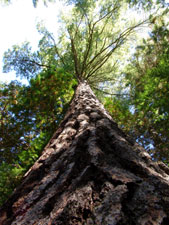
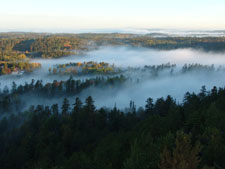
The lodge is located directly in front of Temagami's White Bear Old Growth Red and White Pine Forest. Originally destined to be a clear-cut logging operation by the MNR, the community rallied together in the early '90's and had it preserved as a Conservation Reserve. An extensive trail system now interconnects this 800 hectares (2000 acres) of unspoiled ancient wilderness which contains many red pines over 1 Meter (3 Feet) and white pines up to 1 1/2 Meters (5 Feet) in diameter and is the sixth largest stand of old growth pine remaining in the world. Several species of plants, including rare northern orchids and fungi which are native to an undisturbed eco-system can be found here (described below in more detail).

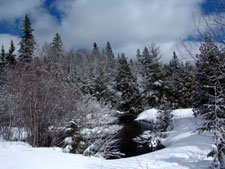
Guided or self-guided tours are available all year either by hiking boots or snowshoes . During the summer, a water taxi is available for a drop-off at one location and pick-up at another to eliminate walking the same path twice for people preferring a self-guided tour. Departure and arrival times can be arranged for your convenience. Guided tour departure/arrival times are also easily arranged to suit any schedule. In the winter months, shuttles by snowmobile can be arranged to the beginning of the trail system at several locations for people looking for quick access. Others prefer the scenic 2 km. excursion by snowshoes (rentals available) or their own XC skis, directly from the lodge.

Guided tours by a semi-professional free-lance photographer can be arranged by the half or whole day. Come as an individual or as a group to see nature through your own still format (film or digital) camera or VCR. Camouflaged stands are available for wildlife viewing opportunities. A user-friendly portable tree stand is available for photographers, painters or anyone just wanting to catch a glimpse of the forest from an elevated position. We can supply everything except cameras. Black and white darkroom facilities are available on-site at no additional charge on some package plans.
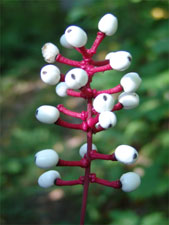


Wild Orchids of Northern Ontario

Throughout the Temagami area, in a few select locations, can be found several species of rare wild orchids that are native to northern Ontario. Growth is noticeable after the last dangers of a spring frost have passed and the flowers of some species will begin to bloom in late May while others start in late August and continue through September. The best bloom time can vary by up to a couple weeks, depending mainly on spring's arrival time which varies each year. Also, not every species will bloom every year which I can only suspect is dependant upon a perfect combination of sunlight, temperature and precipitation.

In 2005, I had positively identified seven different species of native northern orchids and at that time, I was certain that there are at least five more orchids that would be located in future field trips in coming years if the growth conditions were ideal for those select species.

In the summer of 2006, I found two more species that were not part of the previous year's list of suspected orchids: the Bog Orchid was first observed on July 13 and then the Rein Orchid was found on July 19. On July 23, I found several of the club spur orchids (one of the suspected five other orchids) which had not been visible a few days earlier. This brings the total identified species of orchids in the Temagami area to ten, as of today. The search continues for the other four.

It's spring, 2007. I have literally stumbled upon another new (to me) species of orchids today, June 9. While searching (without any luck) for a couple of different species that are reportedly in the area, I  located a small but rather dense patch of Early Coralroot orchids. Three more species to go.

It is now July 3 and new species of orchids appear every time I get a chance to explore the forest. Exquisite in both size and fragrance, the Showy Lady's Slipper was very obvious in places that I've never seen it before. An unpredictable orchid, it can lay dormant for up to 4 or 5 years before suddenly appearing in thick masses. It was known to be one of the "usual suspects". An unexpected find, growing amongst the countless Lady's Slippers, was the new-to-me White Adder's Mouth Orchid. Thirteen down and still 2 known species to locate.

Two more unknown orchids were located on July 8, 2007. After close examination, they were identified as the Heart Leaved Twayblade (at 3 inches tall) and the Menzies' Rattlesnake Plantain Orchid. The latter was first believed to be a Checkered Rattlesnake with poor leaf markings but was soon distinguished from its close relative. On July 24, 2007 another new orchid was located which was determined to be a Lesser Rattlesnake Plantain Orchid with its distinctive "snake-skin" pattern leaves. Also noted at this time were budding Helleborine orchids which were photographed in early August. This brings the total to 17 identified species of native northern wild orchids. There are still two species known to grow in the Temagami area that I have not been able to locate. Maybe next year.

A word of advice for guests wishing to photograph these flowers: be prepared to get wet! Orchids characteristically grow in floating peat bogs, fens, swamps and marshes as well as in other low laying wet soil conditions. Knee high rubber boots or a very old pair of running shoes are the preferred footwear for these excursions. Only a few select species can live on drier ground such as those found on forest floors. Insect repellant is a necessity during May and June and is optional during the remainder of the summer.

It is imperative that extreme caution be taken while photographing these delicate plants so as not to inflict any harm to the plant, its root system or any other flora in the immediate area.

The orchids that I have identified are as follows:

The Pink Lady's Slipper (Cypripedium acaule) or Pink Moccasin Flower is the earliest flowering orchid in the area and appears from late May through mid June every year. At 8 to 12" (15 to 30 cm.) with a bright solitary pink flower, it is quite common and can easily be seen in drier acidic soils in undisturbed old growth forests of red, white and jack pines. The two large leaves growing from the bottom of an elongated stalk resemble the leaves of an oversized Lily of the Valley.

The Early Coralroot (Northern Coralroot) (Corallorhiza trifida) can be easily identified by the white color on its three lobed lip which sits atop a smooth, leafless greenish-yellow stalk of the same color. It has a paler tubular sheath around the lower parts of the stalk. Growing in clusters of up to 30 stalks, it is found on cool shady soils under conifers (balsam, spruce, pines) or mixed forests with added birch or poplar. Standing at 4 to 8" (10 to 20 cm.), it can be found in locations near Rein Orchids or Checkered Rattlesnake Plantain Orchids. Bright yellow, drooping, fat seed pods in the late summer are more conspicuous than the earlier flowers.

The brightly colored Arethusa (Arethusa bulbosa) or Dragon's Mouth Orchid makes a very brief appearance in early to mid June in fens that are fed with cool running clear water. Although quite common in some years, it can be completely absent for the next one or two years. A short orchid of only 4 to 8" (10 to 20 cm.), it is found in the same growing areas as the Grass Pinks, Rose Pagonias and non-orchid plants such as the Pitcher Plants and occasionally Sundews.

The Grass Pink Orchid (Calopogon tuberosus) has a very bright purple/pink flower with an equally bright yellow stamen and long, grassy-like leaves. It also has a short life cycle in early June to mid July and is also found in cool water fens where it prefers bright sunlight. A relatively rare but tall orchid at 10 to 24" (25 to 60 cm.) with several flowers opening from the bottom up on one long, woody stem, several will be found growing in close proximity. Its "neighbors" include Arethusas, Rose Pagonias and Pitcher Plants.

The Rose Pogonia (Pogonia ophioglossoides) or Snake Mouth Orchid is a very delicate and beautiful but rank smelling flower, similar to the odor of a snake. The short lived pink flowers appear for only four to seven days from early June to mid July. Extremely rare overall but abundant where found, it also inhabits fens and peat bogs and prefers bright sunlight. One of the shortest bog orchids, it is only 3 to 8" (8 to 20 cm.) and has just one leaf, similar to the Lily of the Valley, growing from the bottom of each stem. Its neighbors" include Arethusas, Grass Pinks, Sundews and Pitcher Plants.

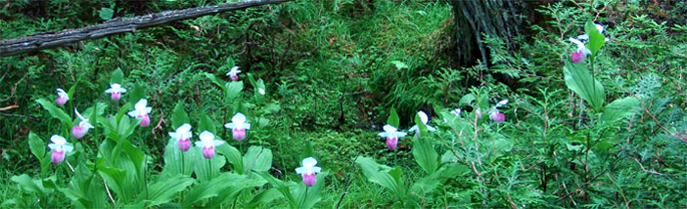
The Showy Lady's Slipper (Cypripedium reginae) is the largest and showiest of the wild orchids. The name, reginae means "queen" and is indicative of this beautiful plant. The "wings" are white with the bulb being colored with pale to deep pink stripes, often almost completely coloring the large bulb of the "slipper". The white, triangular stamen is tipped in yellow and is sterile. Both the flower and stalk are waxy in appearance but are covered in fine hair which some people find to be irritating and occasionally toxic. Being extremely fragrant, it is often located by smell alone before the flowers and tall stems of 8 to 30" (20 to 80 cm.) give it away. Several deeply ribbed, bright green leaves spiral up the stalk. This orchid can be very prolific one year and then be completely absent for up to 4 or 5 years. It grows in boggy cedar swamps in close proximity to cold bottom fens. Occasionally, there may be 2 flowers on the same stalk. With a short life span of only a few days, flowers appear in late June through early July.

The White Adder's Mouth Orchid (Maxalis monophyllos) has one of the smallest flowers of all the orchids. There can be up to 25 or 30 of them evenly spaced along a 6 to 8" (15 to 20 cm.) stalk. Found mainly in boggy cedar swamps and fens, they can be easily overlooked since their green, fleshy stalks and flowers blend in with the sphagnum moss they live in. A single, waxy and solitary, deep-veined leaf sheaths the stem part way up the stalk. Flowers appear in late June through early July.

The almost inconspicuous Heart Leaved Twayblade (Listera cordata) derives its name from the horizontally-flat, heart shaped pair of opposing leaves half way up its hairy stalk. The flowers (3 to 5 mm long) can vary from white (here) to slight tinges of either green or purple and only last from 3 to 5 days. The seed pods form quickly after pollination, as seen here on the lower flowers which resemble tiny balloons. At 2 to 4" (5 to 10 cm.), it is one of the smallest orchids and grows in "cold bottom" fens with sphagnum moss areas under cedar and spruce trees near Rein Orchids and Lesser Rattlesnake Plantains. Although it is extremely rare, it can be found from late June through mid July.

Menzies' Rattlesnake Plantain (Goodyera oblongifolia) has a basal rosette of 3 or 4 oblong leaves, easily distinguishing it from other Plantains although it has the least-marked checkerboard leaves. Common to shady areas under cedar and spruce trees, it can be nearly unnoticeable if found in thick sphagnum ground cover. Three to ten greenish-white flowers appear to be growing only on one side of the hairy stalk which can be from 4 to 10" (10 to 25 cm.) in height. The flowers last quite a while from late June through mid to late July.

The Purple Fringed Orchid (Platanthera psycodes) most closely resembles a Hyacinth flower in both appearance and fragrance. Each dime-sized, lilac colored flower on the stalk has noticeably fringed three-parted lips and the leaves are long and grassy shaped. At an overall height of 6 to 18" (15 to 50 cm.), it is easily recognized in open wet meadows, gravel swamps and is rarely seen growing very far from open water. Flowers appear from late June through mid to late July.

The Tall White Bog Orchid (Platanthera dilatata) is the only known snow white orchid in this area. Reaching a height of 8 to 24" (20 to 70 cm.), it can be found in bright sunlight and stands out against the green vegetation. Extremely rare overall, it can be found in fens in close proximity to pitcher plants and sundews. It is also a very fragrant flower and smells like vanilla or cinnamon. Note: the wide base of the lip of the flower is uncharacteristic of most orchids. Flowers appear from late June to mid to late July.

The Blunt Leaf Rein Orchid (Platanthera obtusata) is a very small and well camouflaged orchid and one of the few known to be pollinated by mosquitoes. Extremely rare, it is found in drier soils close to cold water fens and in proximity to the shade from white cedars, black spruce and occasionally, mixed white birch stands. It grows among other acid rich soils of low and trailing plants such as wintergreen, twinflower and creeping snowberry. At 2 to 8" (5 to 20 cm.), it has a smooth stalk, one leaf on the ground and 3 to 8 pale green flowers from early to late July.

The Lesser Rattlesnake Plantain Orchid (Goodyera ripens) has a distinctively different basal leaf group than either the Menzie's or Checkered Rattlesnake Orchids but mostly resembles the pattern of a snake's skin. It also prefers a much damper "cold bottom" location than these other two. At a maximum height of 4 to 6" or 10 to15 cm., it is the smallest of the Rattlesnakes. Small white hairy flowers tinged in green or brownish-pink appear from mid July through mid August. It is found in cool sphagnum moss under spruce or cedar trees and near Rein Orchids and Heart Leaved Twayblades.

The Club Spur Orchid (Platanthera clavellata) is easily identified by the club-shaped spur of this small unassuming orchid (height of 4 to 10" or 10 to 25 cm.) that thrives in large colonies in acid soils of sphagnum moss, white cedar, black spruce and tamarack trees. A single leaf, half way up the stem and a few smaller leaflets farther up combined with a bright green-yellow flower head also make it easy to see. It's neighbors includes the sundews, pitcher plants and occasionally the Pink Lady's Slipper. The horizontal flowers on each stem can be seen from mid July through mid August.

The Checkered Rattlesnake Plantain Orchid (Goodyera tesselata) is a late blooming flower found in dry acidic soils consisting of decaying pine and/or spruce needles in old growth forests. The checkered leaves are a mix of light and dark bluish-green and usually appear in groups of four that surround a short hairy stalk of the same color. The cluster of very tiny greenish/bluish/white flowers appear in late July through early September. It is 1 to 2" (3 to 5cm.) wide and only 4 to 8" (10 to 20 cm.) tall. Plentiful in some years, it is a sporadic orchid that may not appear again for two to four years.

The Round Leaf Orchid (Platanthera orbiculata) has two waxy green leaves the size of small plates laying flat on the ground at the base of a very long stem. Rare and distinctive with leaves, stem and flowers (at a height of 6 to 20" or 15 to 50 cm.) all of the same shade of green, it's found in very acidic soils of deep pine needles in undisturbed old growth forests. It will grow only leaves in the first year, leaves and the flower stalk in the second year and then nothing appears in the third year before re-emerging the next year. Leaves appear in mid to late June with white-tinged, green flowers emerging in mid July through mid to late August.

Helleborine (Epipactis helleborine) is a very common orchid found throughout the area in gravel roadsides, sandy areas, dense pine forests or occasionally in lawns and gardens. Dark veined leaves are smooth underneath and slightly hairy above. The tip of the stalk often bends over and downward while in bud but will straighten to 12 to 24" (30 to 65 cm) when flowering. Several flowers along a purplish stalk are pale green to light pink with a greenish lip occasionally tinged with dark purple or red. Each of the short stemmed flowers sit over a long thin bract off the stalk. Flowers appear from late July through mid August.

Although the Pitcher Plant (Sarracenia purpurea) is not an orchid, I have included it in here with them because it is common to find it growing in bogs and fens alongside several of the orchids mentioned above. It is one of the few carnivorous plants found throughout the Temagami area and is approximately 4 to 6" (10 to 15 cm.) in length and 1 1/2 to 2" (3 to 5 cm.) in diameter. Found from early June through freeze-up in the autumn, the base of the plant (flower stalk is not shown) fills with rain water and the interior walls of the bulb secrete a slippery substance with a pleasant aroma to which small insects are attracted. After entering the bulb, they're unable to climb back up the slippery walls and perish in the watery liquid where they're dissolved and absorbed.

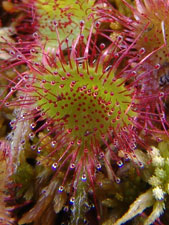
Another carnivorous non-orchid found in clean-water bogs and fens, the Sundew (Drosera rotundifolia) can be found growing just at the waterline or within clusters of green or red sphagnum moss in near proximity to the Pitcher Plant and some of the orchids mentioned above. Although rare overall, when located, there are literally thousands of them and they appear as a red line hugging the waterline and are approximately 1 1/2 to 3" (3 to 5 cm.) high with each plant having a diameter of the same measurements. Those found dispersed in the patches of red sphagnum are much smaller at a height and a diameter of 1/2 to 1" (2 to 3 cm.). This photo is a close-up of the plant where the soft and sticky cactus-like needles produce a sweet smelling substance that small insects are attracted to and are then dissolved and absorbed by the host. A soft fleshy plant, it is found from early June through autumn.


Latin Name

Common Name

Picture

May

June

July

August

September

Cypripedium
acaule

Pink
Lady's Slipper
(Moccasin Flower)
Orchid

Late

Mid

Corallorhiza
trifida

Early (Northern)
Coralroot
Orchid

Early
to
Mid

Arethusa
bulbosa

Arethusa
(Dragon's Mouth)
Orchid

Mid
to
Late

Calopogon
tuberosus

Grass Pink
Orchid

Early

Mid

Pogonia
ophioglossoides

Rose Pogonia
(Snake Mouth)
Orchid

Early
to
Mid

Cypripedium
reginae

Showy
Lady's Slipper
Orchid

Late

Early

Maxalis
monophyllos

White
Adder's Mouth
Orchid

Late

Early

Listera
cordata

Heart Leaved
Twayblade
Orchid

Late

Mid

Goodyera
oblongifolia

Menzies'
Rattlesnake Plantain
Orchid

Late

Mid
to
Late

Platanthera
psycodes

Purple Fringed
Orchid

Late

Mid
to
Late

Platanthera
dilatata

Tall White Bog
Orchid

Late

Mid
to
Late

Platanthera
obtusata

Blunt Leaf
Rein
Orchid

Early
to
Late

Goodyera
repens

Lesser
Rattlesnake Plantain
Orchid

Mid

Mid

Platanthera
clavellata

Club Spur
Orchid

Mid

Mid

Goodyera
tesselata

Checkered
Rattlesnake Plantain
Orchid

Mid

Mid

Platanthera
orbiculata

Round Leaf
Orchid

Mid

Mid
to
Late

Epipactis
helleborine

Helleborine
Orchid

Late

Mid

Sarracenia
purpurea

Pitcher Plant

Early

All

All

Late

Drosera
rotundifolia

Sundew

Early

All

All

Early

Check-in times for weekly packages are after 2:00 p.m. on Saturdays and check-out times are before 11:00 a.m. on the following Saturdays. For overnight packages, the same times apply for each day. Please inquire about any variations that can be made to these time schedules.

Responsible use of alcoholic beverages is allowed on lodge property. However, we are not a licensed outlet for the sale of these beverages.

Pets are always welcome.

Key Benefits

  • Easy access by motor boat, canoe or land trails to the White Bear Forest.

  • Free instructional lessons on all guided tours.

  • Knowledgeable staff to assist you with species identification.

Prices

Description

Guiding

Daily Rates

1 to 6 People

7 or More

Half Day - $100.00

$15.00 p.p.

Whole Day - $150.00

$20.00 p.p.

Water Taxi
(to White Bear Forest)

$25.00 minimum or $15.00 per person

Snowshoe Rental

$15.00 a day /$90.00 a week

Tree stand Rental

$25.00 a day or $125.00 a week

Tri-pod Rental

Half Day - $10.00 - Whole Day - $15.00

Boat Rental

Half Day - $40.00 - Whole Day - $70.00

Note: Damage deposit required on all rentals.

All reservations require a 50% deposit by credit card.
Cancellations with refunds are accepted prior to 30 days before date of arrival.

No monetary refunds for early returns on rentals.

Send mail to paradise@onlink.net with questions or comments about this web site.